
Social networks are everywhere. Facebook, Instagram, LinkedIn, Reddit, and other platforms have made online communities a normal part of everyday life.
But what if you want to build your own social networking website instead of creating a community on someone else’s platform?
You don’t necessarily have to develop everything from scratch.
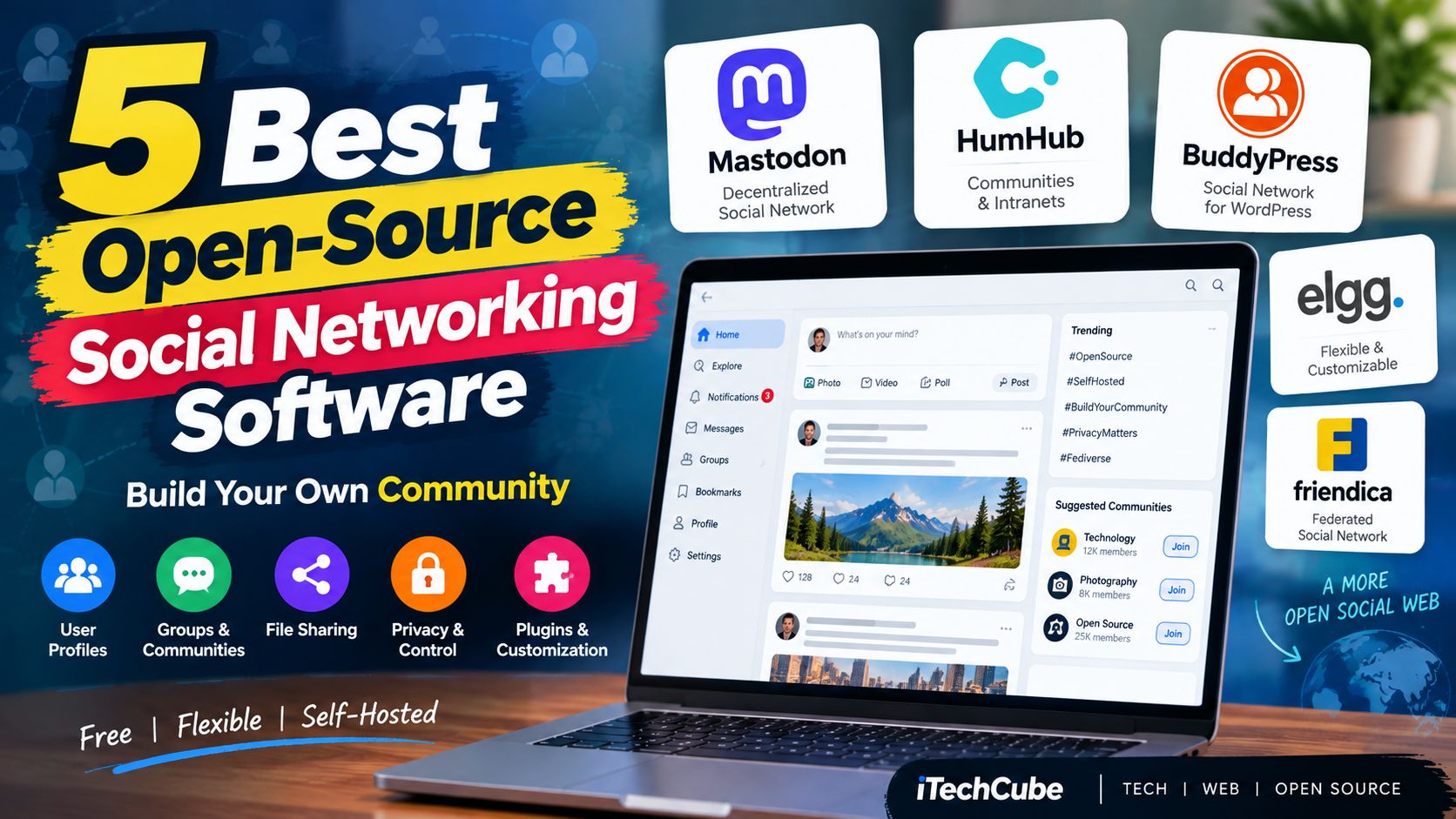
There are several free and open-source social networking software projects that can give you the foundation for building your own community, private network, social intranet, or even a decentralized social platform.
Some are designed for traditional community websites, while others are built around the modern Fediverse and decentralized social web.
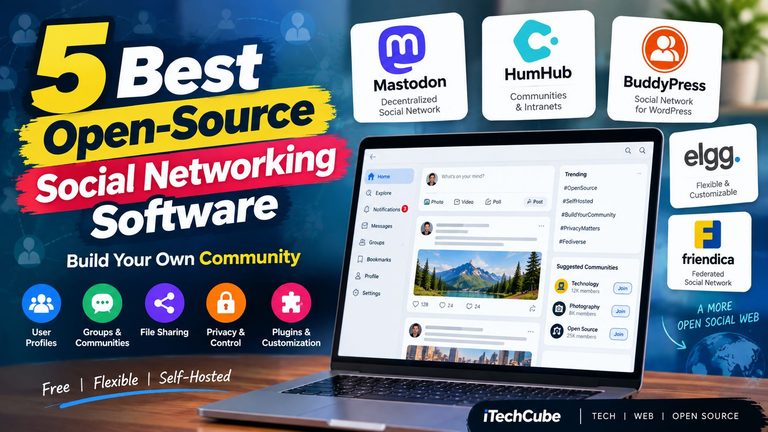
In this guide, we’ll look at 5 open-source social networking platforms worth considering in 2026.
What Is Open-Source Social Networking Software?
Open-source social networking software provides the source code and core functionality needed to create or operate your own social network.
Depending on the platform, you may get features such as:
- User profiles
- Activity feeds
- Posts and comments
- Groups or communities
- Private messaging
- Notifications
- Media sharing
- Forums or discussions
- User permissions
- APIs and integrations
- Themes and plugins
- Decentralized or federated communication
The major advantage is control. Instead of depending completely on a large social media company, you can host and customize the software yourself.
Keep in mind that free software does not mean free hosting. You may still need a domain, web hosting or VPS, backups, maintenance, and technical administration.
1. Mastodon
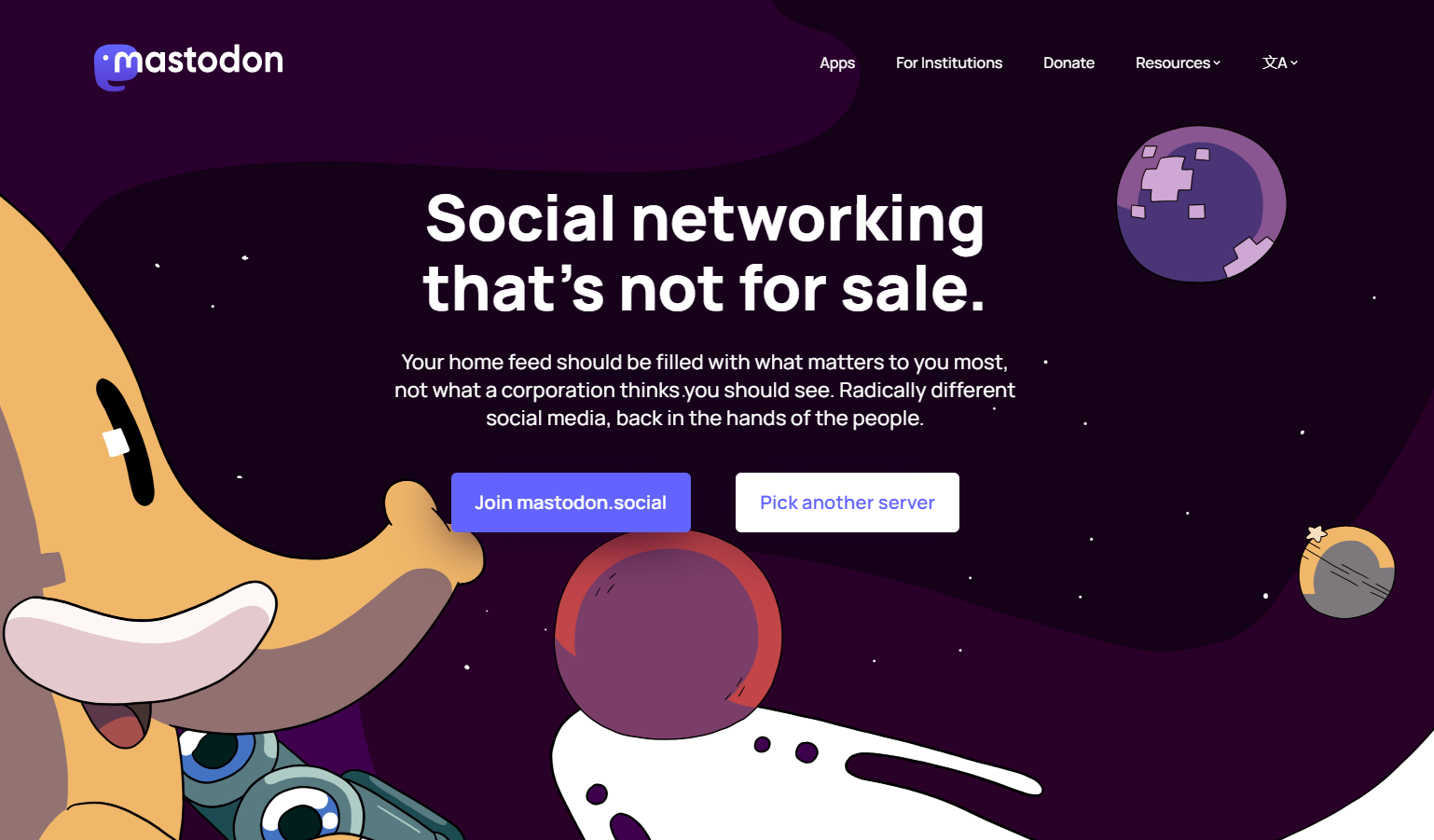
Mastodon is one of the best-known open-source projects in the decentralized social networking space.
Unlike a traditional social network where everything is controlled by one company, Mastodon uses a federated architecture. Different servers can operate independently while still communicating with each other through ActivityPub.
Users can publish text, images, video and other content, follow people, interact with posts, and communicate across compatible servers.
Mastodon is free and open-source software and is licensed under AGPLv3. Its servers can also communicate with other ActivityPub-compatible platforms in the Fediverse.
Key features
- Decentralized social networking
- ActivityPub support
- User profiles and following
- Posts with images and video
- Polls
- Content warnings
- Custom emojis
- Media attachments
- Moderation tools
- Self-hosting
- Fediverse interoperability
Who should use Mastodon?
Mastodon is particularly interesting if you want to build or operate a decentralized social community rather than a traditional single-server social network.
It is also a good option for developers interested in the Fediverse and ActivityPub ecosystem.
Website: joinmastodon.org
2. HumHub
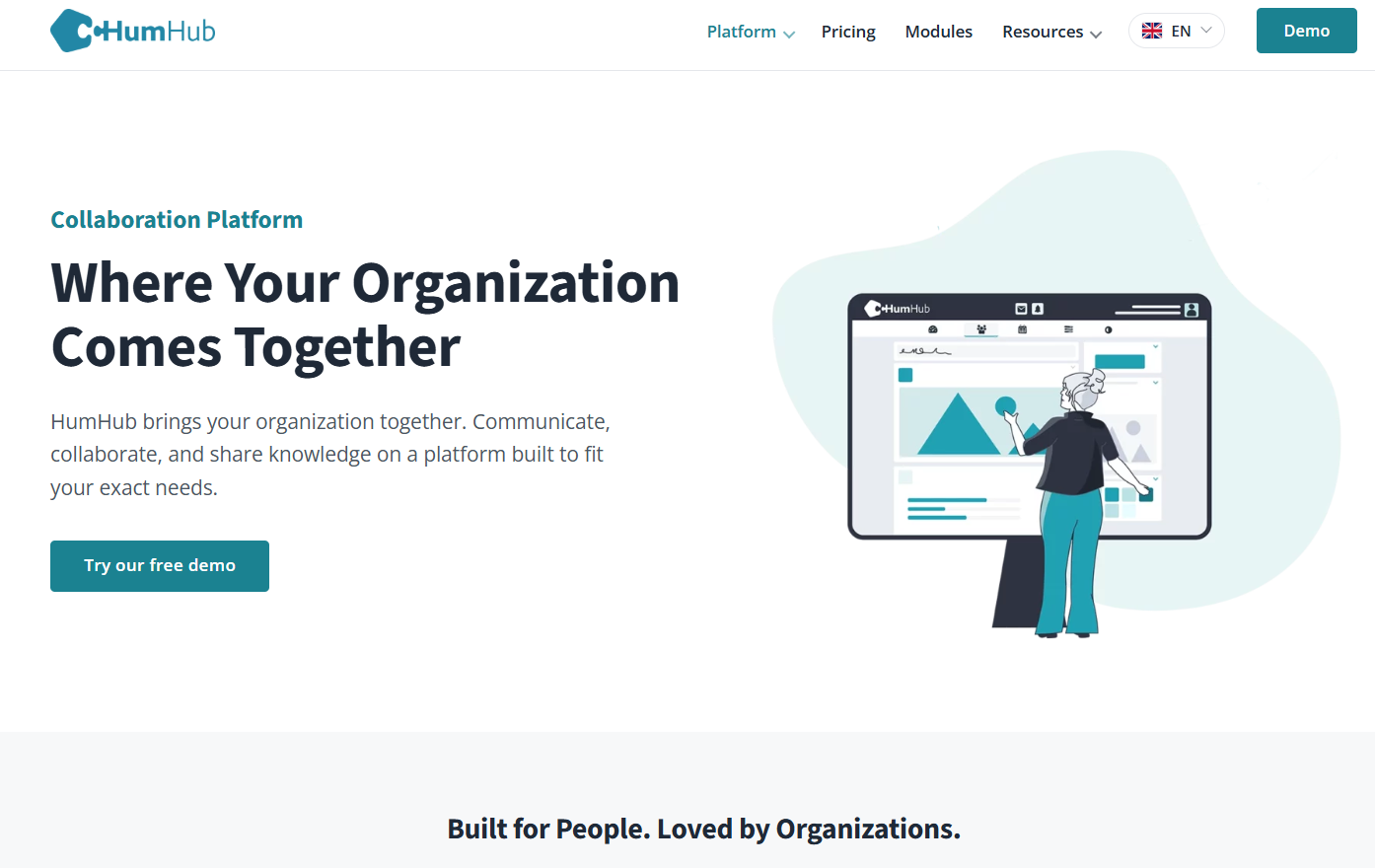
If your goal is to create a private social network, company intranet, school community, organization network, or collaboration platform, HumHub is worth looking at.
HumHub describes itself as an open-source social network platform that can be used for public or private communities, enterprise social intranets, schools, agencies, municipalities, and associations.
The platform is built around users, spaces, content, and modules. You can create spaces for different teams or communities and extend the platform with additional modules.
Key features
- User profiles
- Activity streams
- Groups and Spaces
- Posts and comments
- File sharing
- Calendar and events
- Wiki functionality
- Tasks
- Notifications
- Private messaging
- Themes
- Modules
- APIs
- Custom permissions
HumHub currently offers a free Community Edition that can be self-hosted. Its core is open source and licensed under AGPLv3.
Who should use HumHub?
HumHub is particularly suitable for:
- Company intranets
- Private communities
- Schools
- Universities
- Clubs and associations
- Internal communication
- Collaboration platforms
If you want something that feels more like a private Facebook-style community combined with collaboration tools, HumHub is an interesting option.
Website: humhub.com
3. BuddyPress
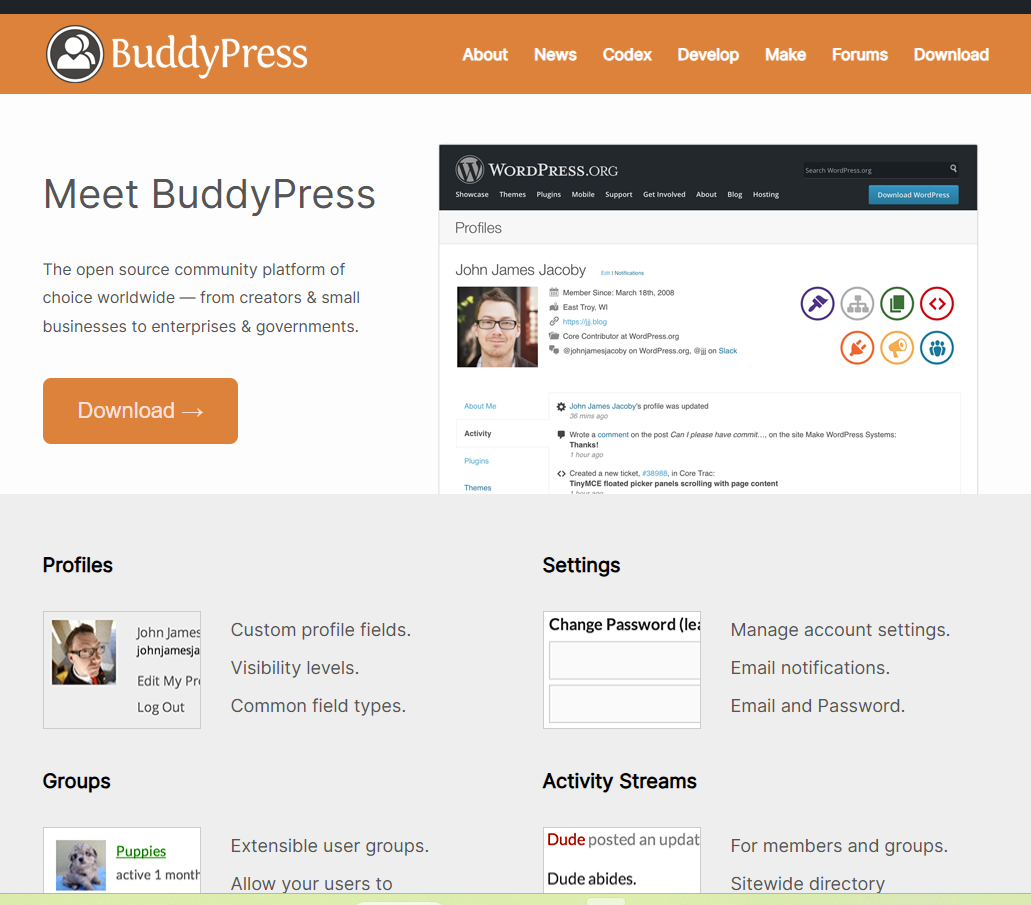
If you’re already familiar with WordPress, BuddyPress is one of the easiest ways to add social networking functionality to a WordPress website.
Instead of installing a completely separate social networking platform, BuddyPress works as part of the WordPress ecosystem.
It can turn a regular WordPress website into a community where members can create profiles, communicate, participate in groups, and interact with each other.
BuddyPress is completely open source and has been developed as an extensible community project since its early releases.
Key features
- Member profiles
- Activity streams
- Groups
- Private messaging
- Friend connections
- Notifications
- Member directories
- User-generated content
- WordPress theme compatibility
- Plugin extensions
One useful aspect of BuddyPress is that you don’t have to enable everything. Features can be enabled or disabled depending on the type of community you’re building.
Who should use BuddyPress?
BuddyPress can be a practical choice for:
- WordPress websites
- School communities
- College networks
- Membership websites
- Niche communities
- Professional communities
- Company intranets
If you already run WordPress and want to add community functionality, BuddyPress is worth investigating before building an entire social network from scratch.
Website: buddypress.org
4. Elgg
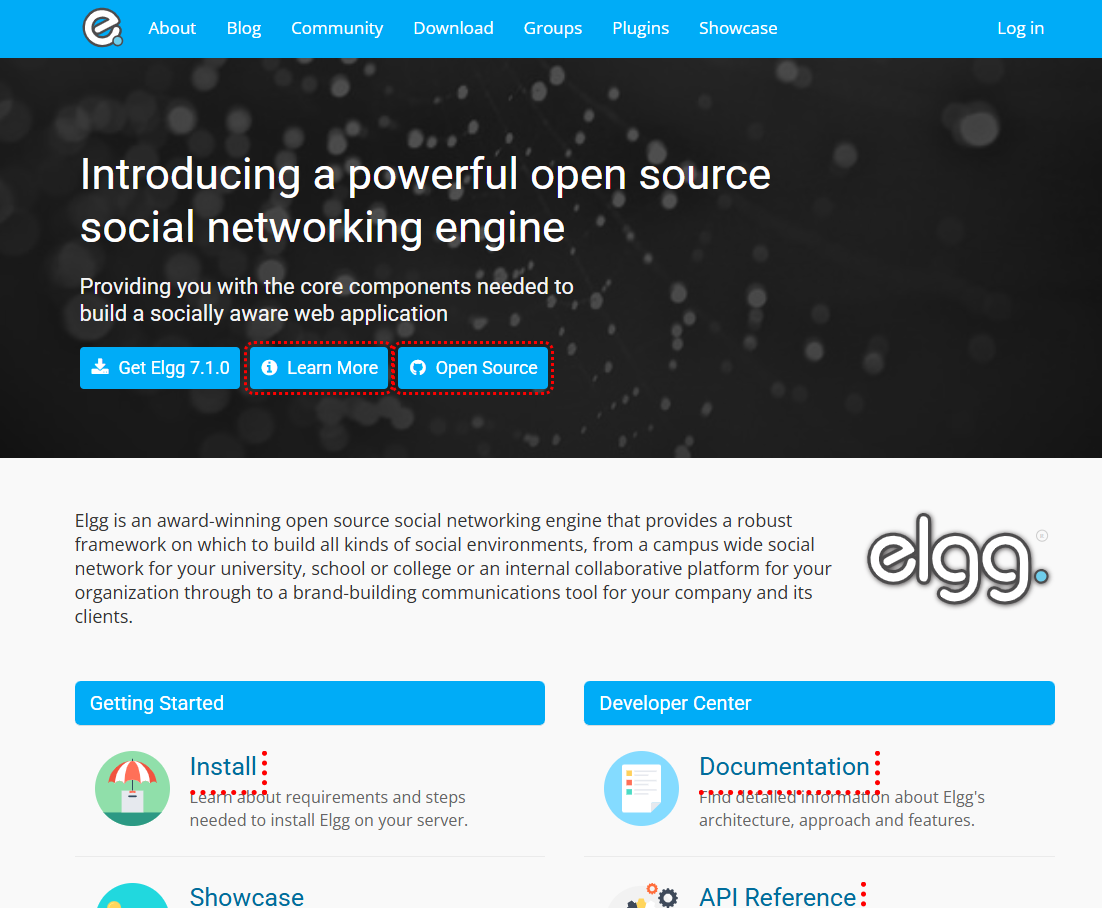
Elgg is a long-running open-source social networking engine designed for developers and organizations that want to build customized social environments.
Unlike software that tries to be a ready-made copy of a particular social network, Elgg provides a framework and core components that can be adapted to different use cases.
The project is still actively maintained. Elgg’s official website currently lists version 7.1.0, released on September 10, 2026, as its latest stable release, with a 6.3.8 LTS release also available.
Key features
- User profiles
- Activity streams
- Social connections
- Groups
- Content sharing
- Plugins
- Custom themes
- APIs
- Authentication options
- Developer-friendly architecture
- Community extensions
Elgg is licensed under GPLv2, with some code available under MIT depending on the release configuration.
Its architecture is designed to be extended through plugins, themes, hooks, events, and APIs, making it particularly interesting for developers who want to create a customized community platform.
Who should use Elgg?
Elgg can be useful for:
- Custom social networks
- Educational communities
- University networks
- Company communities
- Membership websites
- Niche social platforms
- Developer-led projects
If customization is more important to you than having a completely ready-made social network out of the box, Elgg is worth considering.
Website: elgg.org
5. Friendica
Friendica takes a different approach from traditional social networking software.
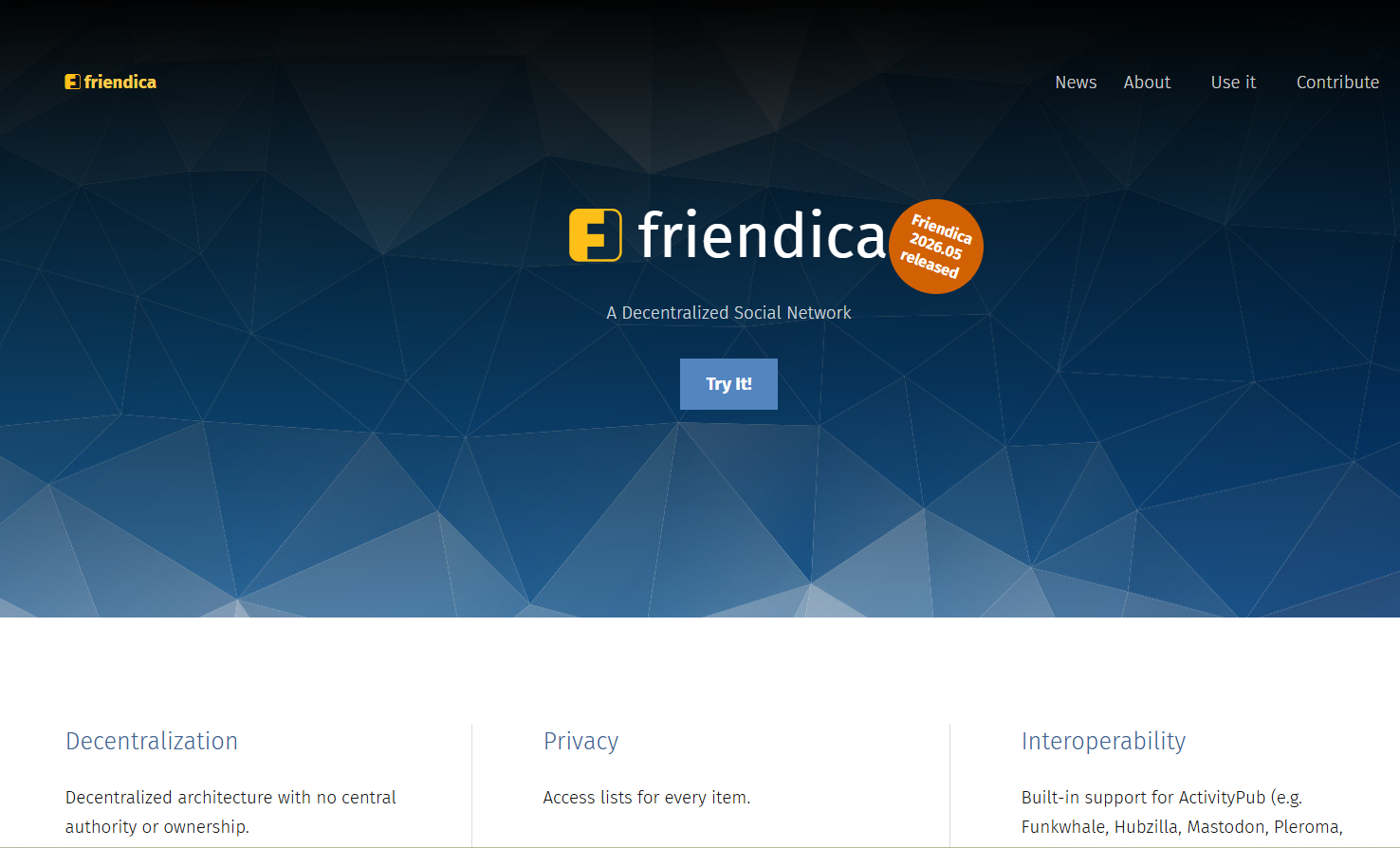
It is a decentralized social networking platform designed to connect different social networks and services.
Friendica is part of the broader Fediverse and supports communication through protocols including ActivityPub. It can interact with platforms such as Mastodon, Lemmy, Diaspora, Pixelfed, PeerTube and others.
The software is free and open source under the AGPLv3-or-later license and can be installed on your own server using PHP and MySQL.
Key features
- Decentralized architecture
- ActivityPub support
- User profiles
- Posts and comments
- Social connections
- Privacy controls
- Cross-platform communication
- Fediverse integration
- Self-hosting
- Add-ons and extensions
One of the interesting things about Friendica is that you don’t have to think of your community as an isolated website. Its interoperability allows users to communicate across compatible networks.
Who should use Friendica?
Friendica may be suitable for:
- Decentralized social networks
- Privacy-focused communities
- Fediverse projects
- Self-hosted social platforms
- Developers interested in interoperability
Website: friendi.ca
Open-Source Social Networking Software Comparison
| Software | Best For | Self-Hosted | Decentralized | Extensible |
|---|---|---|---|---|
| Mastodon | Federated social network | Yes | Yes | Yes |
| HumHub | Private communities & intranet | Yes | No | Yes |
| BuddyPress | WordPress communities | Yes | No | Yes |
| Elgg | Custom social networks | Yes | No | Yes |
| Friendica | Federated social networking | Yes | Yes | Yes |
These platforms aren’t direct substitutes for one another. Their architectures and intended use cases are different. For example, Mastodon and Friendica focus heavily on decentralized communication, while HumHub and BuddyPress are more suited to controlled communities or organization-based networks.
How to Choose the Right Open-Source Social Network Software
Before installing any platform, think about what you actually want to build.
For a decentralized social network
Look at Mastodon or Friendica.
These are designed around federated communication and the broader Fediverse.
For a company or private community
HumHub is worth considering because it is designed for social intranets, organizations, schools, associations, and private communities.
For a WordPress website
BuddyPress is the natural option to investigate because it extends WordPress with social networking functionality.
For a highly customized platform
Elgg provides a developer-oriented framework with plugins, themes, APIs, and extension points.
Things to Consider Before Self-Hosting
Installing open-source software is only the beginning.
If you’re planning to operate a real social network, you should also think about:
Hosting
A small community may work on modest hosting, but a growing social network can require considerably more CPU, RAM, storage, and database resources.
Security
You are responsible for keeping the software, server, plugins, themes, and dependencies updated.
Backups
User-generated content can become extremely valuable. Maintain regular database and file backups.
Moderation
A public social network needs tools and policies for handling spam, abuse, illegal content, impersonation, and other moderation issues.
Registration, password resets, notifications, and other features may require properly configured transactional email.
Scaling
If your community grows, you may eventually need caching, CDN services, optimized databases, background jobs, object storage, and additional servers.
Can You Build Your Own Facebook-Like Website With Open-Source Software?
Yes, but it is important to understand what that means.
Open-source social networking software can provide the foundation for your platform, but you should not expect to install one of these projects and instantly have a complete replacement for Facebook.
Your final website may require:
- Custom branding
- UI/UX changes
- Plugins or modules
- Custom development
- Mobile applications
- Payment integration
- Moderation tools
- Analytics
- Search
- Notifications
- Server infrastructure
- Security configuration
The advantage is that you start with an existing foundation instead of developing every social networking feature from zero.
Final Thoughts
Open-source social networking has changed considerably since the early days of Facebook-style clone scripts.
Projects such as Mastodon and Friendica demonstrate the growing importance of decentralized and federated social networks, while HumHub, BuddyPress, and Elgg continue to provide different approaches for building communities, intranets, and customized social platforms.
The right choice depends less on finding a single “best” platform and more on deciding what type of community you want to build.
If you’re starting a WordPress-based community, BuddyPress can be a straightforward direction.
If you’re building an organization or private community, HumHub may fit the use case.
If you’re interested in the decentralized web, Mastodon or Friendica can be explored.
And if you’re a developer looking for a customizable social networking framework, Elgg remains an active open-source option.
The good news is that you no longer need to start a social networking project completely from scratch.