
Home Blog

10 Best AI Tools for Creators to Boost Your Productivity

Creating content sounds easy until you actually have to do it.

One day you’re writing a blog post, the next you’re editing a video, creating a thumbnail, replying to comments, preparing social media posts, and trying to come up with the next great idea. Before you know it, most of your time is spent on small tasks instead of actually creating.

This is where AI tools can make a real difference.

AI isn’t going to replace creativity, but it can take care of a lot of repetitive work. From writing and research to image creation, video editing, and audio production, there are now tools that can save creators hours every week.

Best AI Tools for Creators

I’ve put together 10 AI tools that are particularly useful for creators. You don’t necessarily need all of them. In fact, finding two or three that fit your workflow is usually more useful than signing up for every AI tool you come across.

Best AI Tools for Creators

1. ChatGPT – For Ideas, Writing and Research

OpenAI’s ChatGPT is probably one of the most versatile AI tools available to creators.

You can use it to brainstorm blog topics, create content outlines, rewrite paragraphs, generate social media ideas, summarize information, write video scripts, create email drafts, or even help with coding and technical tasks.

The important thing is not to simply ask it to “write an article.” The better results usually come when you give it context, explain your audience, and tell it what kind of content you’re trying to create.

Best for: Bloggers, writers, marketers, YouTubers, developers

My take: Think of ChatGPT more like a creative assistant than a replacement for your own writing.

2. Canva – Create Designs Without Being a Designer

Canva has become a go-to tool for creators who need to produce graphics quickly.

Its AI-powered features can help with things like generating design ideas, creating images, writing copy, resizing designs, and editing existing graphics.

It’s particularly handy when you need several versions of the same content. For example, you might create a YouTube thumbnail and then need versions for Instagram, Facebook, and your website.

Instead of starting everything from scratch, Canva can speed up much of that process.

Best for: Social media creators, bloggers, marketers, small businesses

3. Adobe Firefly – AI Image and Creative Generation

If you regularly work with images, Adobe Firefly is worth checking out.

Firefly can generate images from text prompts and is also integrated into Adobe’s wider creative ecosystem. This makes it useful for creators who already use Photoshop or other Adobe applications.

For example, you can generate a background for a thumbnail, remove unwanted elements from an image, or experiment with different visual concepts before creating the final design.

It’s especially useful during the early stages of a project when you’re trying to turn an idea into something visual.

Best for: Designers, photographers, marketers, content creators

4. Grammarly – Improve Your Writing

Not every creator needs AI to write an entire article. Sometimes you just need someone to catch the awkward sentence you somehow didn’t notice after reading it five times.

That’s where Grammarly can help.

It can check grammar, spelling, clarity, tone, and other aspects of your writing. Its AI features can also help rewrite text or adjust the tone depending on what you’re trying to communicate.

For bloggers and people who write emails, social posts, proposals, or business content regularly, this can be a useful final check before publishing.

Best for: Bloggers, writers, students, professionals

5. Descript – Edit Videos by Editing Text

Video editing can take a surprising amount of time, especially when you’re working with talking-head videos, tutorials, podcasts, or interviews.

Descript takes a slightly different approach. It transcribes your video and allows you to edit the recording by editing the transcript.

That means you can remove a sentence from the transcript and have it removed from the video as well.

Descript also includes AI features for things like removing filler words, improving audio, and creating clips from longer recordings.

Best for: YouTubers, podcasters, educators, video creators

6. ElevenLabs – AI Voice and Audio

Audio is another area where AI has become surprisingly useful.

ElevenLabs provides AI voice and audio tools that can be used for voiceovers, narration, dubbing, and other creative projects.

For creators who don’t want to record their own voice for every video, AI voice generation can be a practical option. It’s also useful when producing content in multiple languages.

Of course, the voice you choose matters. A robotic or obviously artificial voice can make otherwise good content feel cheap, so it’s worth spending some time finding a natural-sounding option.

Best for: YouTubers, video creators, podcasters, audiobook creators

7. Perplexity – Faster Research

Research is one of those parts of content creation that can quietly eat up hours.

Perplexity is designed around AI-powered search and research. Instead of opening dozens of pages and trying to piece everything together yourself, you can ask a question and get a summarized answer along with sources to explore.

This can be useful when you’re researching a topic for a blog post, YouTube video, newsletter, or social media content.

I wouldn’t recommend blindly copying an AI-generated answer, though. Always open the original sources and verify important facts, particularly when you’re writing about technology, finance, health, or anything else where accuracy matters.

Best for: Researchers, bloggers, journalists, students, content creators

8. Notion AI – Organize Your Content Ideas

Having ideas isn’t usually the problem for creators. Keeping track of them is.

Notion combines notes, databases, project management, and AI features in one workspace.

You can use it to organize content calendars, store ideas, create outlines, summarize notes, and turn rough thoughts into something more structured.

For example, you could have a database containing hundreds of potential blog topics and use AI to help turn selected ideas into outlines.

Best for: Bloggers, content teams, freelancers, marketers

9. Runway – AI Video Creation and Editing

AI video generation has moved incredibly quickly, and Runway is one of the tools worth watching.

It offers AI-powered tools for generating and editing video, creating visual effects, and experimenting with creative concepts.

You don’t necessarily need to use it to create an entire video. It can be just as useful for generating a short visual, background clip, or creative scene that would otherwise require considerably more production work.

Best for: Video creators, filmmakers, designers, advertisers

10. Zapier – Automate the Boring Stuff

This one isn’t specifically a content-generation tool, but it can have a huge impact on productivity.

Zapier connects different apps and automates repetitive tasks.

For example, you could create workflows that automatically add leads to a spreadsheet, send notifications when a form is submitted, save content ideas, or trigger other actions between the tools you already use.

The less time you spend copying information from one app to another, the more time you have for actual creative work.

Best for: Freelancers, marketers, creators, agencies, small businesses

Which AI Tool Should You Use?

You don’t need to subscribe to ten different AI services just because they’re on a list.

A better approach is to look at where you’re currently losing the most time.

If writing and brainstorming take too long, ChatGPT could be a good starting point.

If you’re constantly creating graphics, try Canva or Adobe Firefly.

For video work, Descript and Runway are worth exploring.

If research is slowing you down, Perplexity can help.

And if your biggest problem is repetitive work between different apps, Zapier may save more time than another writing tool.

The Real Benefit of AI for Creators

The biggest advantage of AI isn’t that it can create something with one click.

It’s that it can remove some of the boring parts of the creative process.

You can spend less time staring at a blank document, searching for the right image, cleaning up a transcript, resizing graphics, or doing repetitive administrative work.

That leaves more time for the part AI still can’t replace easily: your ideas, experience, personality, and understanding of your audience.

The creators who get the most from AI aren’t necessarily the ones using the most tools. They’re the ones who figure out which repetitive tasks can be handed over to AI while keeping the important creative decisions in their own hands.

And honestly, that’s probably the best way to think about AI in 2026: not as a replacement for creativity, but as a productivity tool that gives creators more time to actually create.

Final Thoughts

AI tools are becoming a normal part of the creator’s toolkit. Some will stick around, others will disappear, and new ones will keep showing up.

You don’t have to chase every new AI launch.

Start with one problem in your workflow, find a tool that solves it, and see whether it actually saves you time. If it does, build from there.

The goal isn’t to use more AI.

The goal is to spend less time on the work you don’t enjoy and more time creating the things you do.


ChatGPT vs Claude vs Gemini: Which AI Tool to Use 2026?

ChatGPT vs Claude vs Gemini

The artificial intelligence landscape has shifted from a novelty to an essential utility. By 2026, the market has matured, moving past the “hype phase” into a period of deep specialization. For professionals, students, and developers, the question is no longer whether to use AI, but which model best serves your specific workflow.

While the landscape is crowded, three giants continue to dominate: ChatGPT, Claude, and Gemini. Each has carved out a unique identity, catering to different strengths and user needs.

ChatGPT: The Versatile All-Rounder

OpenAI’s ChatGPT remains the industry standard for general-purpose utility. By 2026, it has evolved into a highly integrated ecosystem rather than just a chatbot.

Why Choose ChatGPT?

ChatGPT excels because of its sheer adaptability. It is the best choice if you need a “jack-of-all-trades” tool. Its strengths include:

  • Multimodal Integration: Seamlessly switching between web browsing, image generation, data analysis, and voice interaction in a single interface.
  • Custom GPTs: The ability to build and deploy personalized bots for specific tasks remains a massive advantage for power users.
  • Broad Ecosystem: With extensive third-party plugins and API support, ChatGPT is often the first tool integrated into professional software suites.

If you want a reliable assistant that handles everything from drafting emails to debugging code and summarizing PDFs, ChatGPT is your go-to.

Claude: The Nuanced Problem Solver

Anthropic’s Claude has gained a massive following among writers, researchers, and developers who prioritize safety and output quality. In 2026, Claude is widely considered the most “human-sounding” AI, capable of handling complex context without losing the plot.

Why Choose Claude?

Claude is designed for depth. It doesn’t just output information; it understands nuance, tone, and logical structures better than most competitors. Key advantages include:

  • Massive Context Windows: Claude can process entire books or massive codebases in a single prompt without “forgetting” the beginning of the conversation.
  • Superior Writing: If your work requires a professional, non-robotic tone, Claude consistently produces the most polished and creative prose.
  • Ethical Guardrails: Anthropic’s focus on “Constitutional AI” makes Claude a preferred choice for companies with strict compliance and safety requirements.

Choose Claude if your work involves long-form content, deep analytical research, or complex logic tasks that require high accuracy and low “hallucination” rates.

Google Gemini: The Ecosystem Powerhouse

Google Gemini has cemented its role as the ultimate collaborator for those living in the Google Workspace. By 2026, Gemini is no longer just a separate app; it is the engine powering Docs, Sheets, Drive, and Gmail.

Why Choose Gemini?

Gemini is the clear winner for efficiency. Its primary selling point is its deep integration into the data you already own.

  • Seamless Integration: You can ask Gemini to find an email from three weeks ago, summarize a report in your Google Drive, and draft a calendar invite—all without leaving your current tab.
  • Real-Time Information: Leveraging Google Search, Gemini remains the fastest at providing up-to-the-second information on current events, stock prices, or breaking news.
  • Multimodal Native Architecture: Built from the ground up to handle video, audio, and text simultaneously, Gemini is unparalleled in processing video content and live streams.

If your life revolves around Google’s suite of applications and you need an AI that knows your schedule and your files, Gemini is the most practical choice.

The Verdict: Which Should You Choose?

There is no single “best” AI. Instead, there is the right tool for your specific goal:

  1. Use ChatGPT if you want a versatile, multimodal assistant that can handle a bit of everything and integrates well with various third-party apps.
  2. Use Claude if you prioritize high-quality writing, deep reasoning, and the ability to analyze massive documents with high precision.
  3. Use Google Gemini if you are a heavy user of Google Workspace and need an AI that can interact directly with your documents, emails, and calendar to save time.

In 2026, the smartest approach isn’t to pick one and stick to it forever. Many power users now subscribe to multiple services, utilizing Claude for their heavy-duty writing, Gemini for their organizational tasks, and ChatGPT for their rapid brainstorming and creative experiments. Assess your workflow today, and don’t be afraid to switch tools to match the specific needs of your project.

Top 5 Free Social networking Open-Source software

Social networks are everywhere. Facebook, Instagram, LinkedIn, Reddit, and other platforms have made online communities a normal part of everyday life.

But what if you want to build your own social networking website instead of creating a community on someone else’s platform?

You don’t necessarily have to develop everything from scratch.

Free Social networking Open-Source software

There are several free and open-source social networking software projects that can give you the foundation for building your own community, private network, social intranet, or even a decentralized social platform.

Some are designed for traditional community websites, while others are built around the modern Fediverse and decentralized social web.

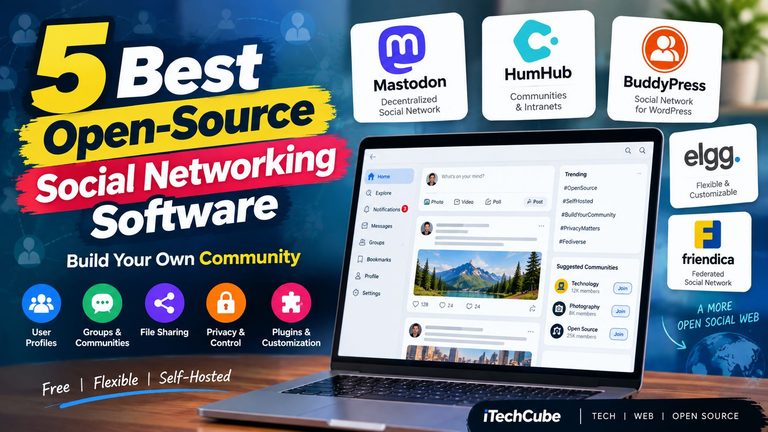
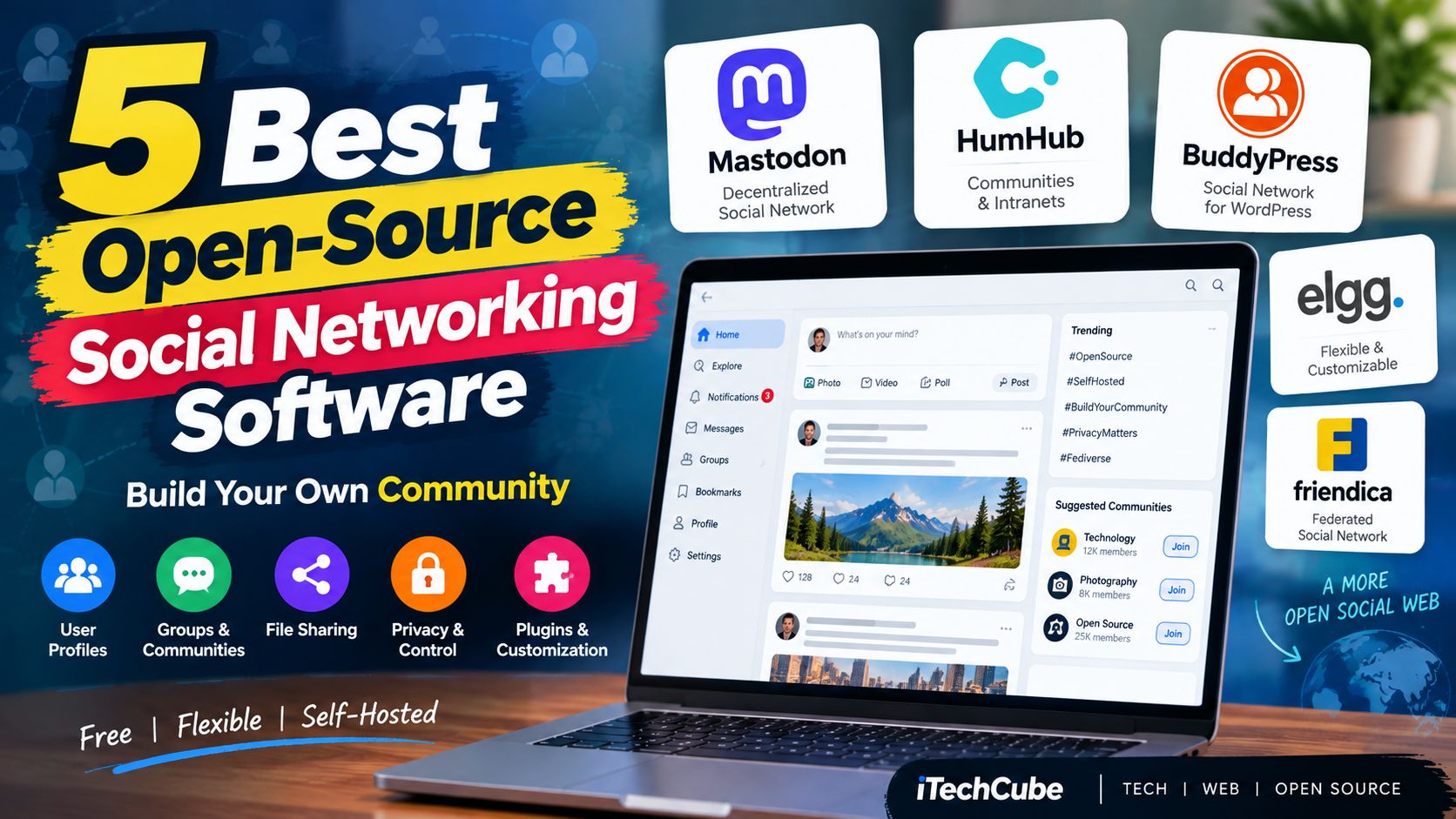
In this guide, we’ll look at 5 open-source social networking platforms worth considering in 2026.

What Is Open-Source Social Networking Software?

Open-source social networking software provides the source code and core functionality needed to create or operate your own social network.

Depending on the platform, you may get features such as:

  • User profiles
  • Activity feeds
  • Posts and comments
  • Groups or communities
  • Private messaging
  • Notifications
  • Media sharing
  • Forums or discussions
  • User permissions
  • APIs and integrations
  • Themes and plugins
  • Decentralized or federated communication

The major advantage is control. Instead of depending completely on a large social media company, you can host and customize the software yourself.

Keep in mind that free software does not mean free hosting. You may still need a domain, web hosting or VPS, backups, maintenance, and technical administration.


1. Mastodon

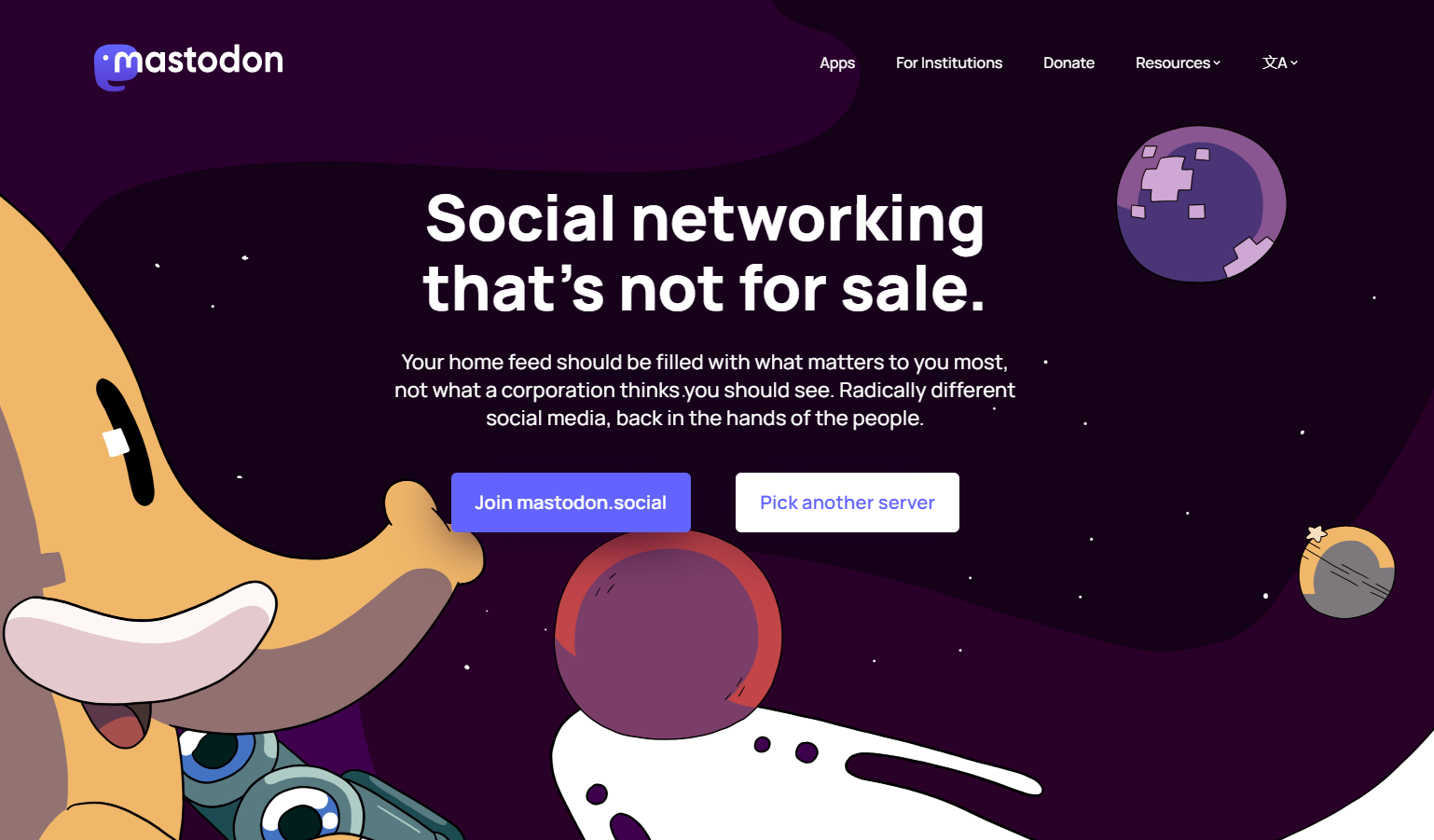
Mastodon is one of the best-known open-source projects in the decentralized social networking space.

Unlike a traditional social network where everything is controlled by one company, Mastodon uses a federated architecture. Different servers can operate independently while still communicating with each other through ActivityPub.

Users can publish text, images, video and other content, follow people, interact with posts, and communicate across compatible servers.

Mastodon is free and open-source software and is licensed under AGPLv3. Its servers can also communicate with other ActivityPub-compatible platforms in the Fediverse.

Mastodon

Key features

  • Decentralized social networking
  • ActivityPub support
  • User profiles and following
  • Posts with images and video
  • Polls
  • Content warnings
  • Custom emojis
  • Media attachments
  • Moderation tools
  • Self-hosting
  • Fediverse interoperability

Who should use Mastodon?

Mastodon is particularly interesting if you want to build or operate a decentralized social community rather than a traditional single-server social network.

It is also a good option for developers interested in the Fediverse and ActivityPub ecosystem.

Website: joinmastodon.org


2. HumHub

If your goal is to create a private social network, company intranet, school community, organization network, or collaboration platform, HumHub is worth looking at.

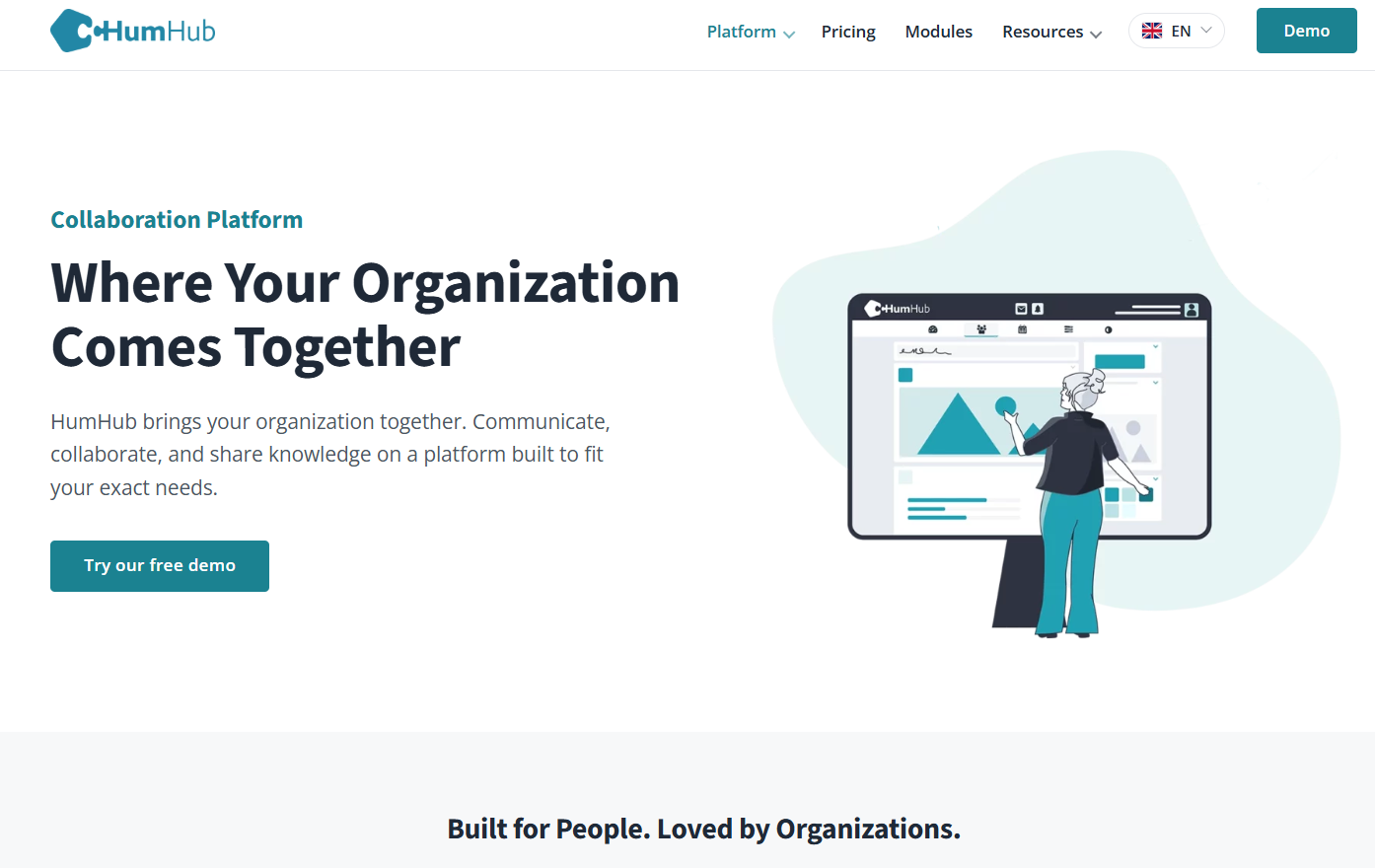
HumHub describes itself as an open-source social network platform that can be used for public or private communities, enterprise social intranets, schools, agencies, municipalities, and associations.

The platform is built around users, spaces, content, and modules. You can create spaces for different teams or communities and extend the platform with additional modules.

humhub

Key features

  • User profiles
  • Activity streams
  • Groups and Spaces
  • Posts and comments
  • File sharing
  • Calendar and events
  • Wiki functionality
  • Tasks
  • Notifications
  • Private messaging
  • Themes
  • Modules
  • APIs
  • Custom permissions

HumHub currently offers a free Community Edition that can be self-hosted. Its core is open source and licensed under AGPLv3.

Who should use HumHub?

HumHub is particularly suitable for:

  • Company intranets
  • Private communities
  • Schools
  • Universities
  • Clubs and associations
  • Internal communication
  • Collaboration platforms

If you want something that feels more like a private Facebook-style community combined with collaboration tools, HumHub is an interesting option.

Website: humhub.com


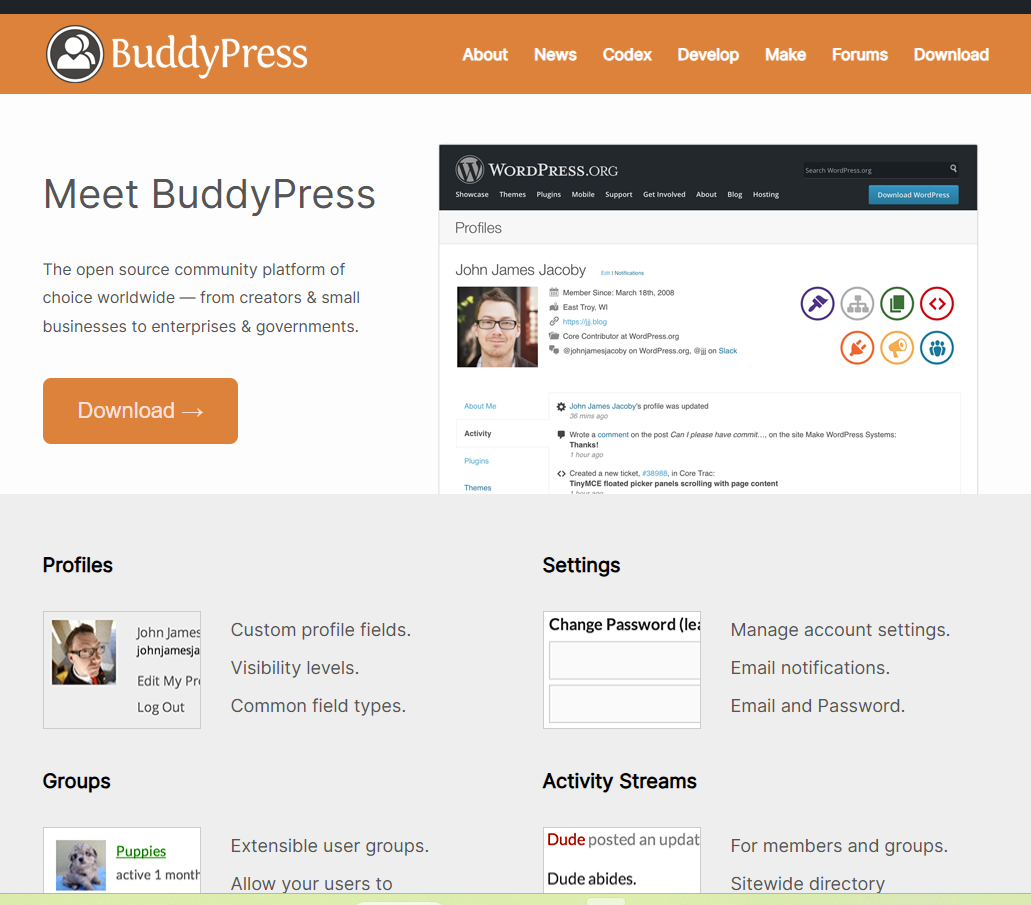
3. BuddyPress

If you’re already familiar with WordPress, BuddyPress is one of the easiest ways to add social networking functionality to a WordPress website.

Instead of installing a completely separate social networking platform, BuddyPress works as part of the WordPress ecosystem.

It can turn a regular WordPress website into a community where members can create profiles, communicate, participate in groups, and interact with each other.

BuddyPress is completely open source and has been developed as an extensible community project since its early releases.

BuddyPress 1

Key features

  • Member profiles
  • Activity streams
  • Groups
  • Private messaging
  • Friend connections
  • Notifications
  • Member directories
  • User-generated content
  • WordPress theme compatibility
  • Plugin extensions

One useful aspect of BuddyPress is that you don’t have to enable everything. Features can be enabled or disabled depending on the type of community you’re building.

Who should use BuddyPress?

BuddyPress can be a practical choice for:

  • WordPress websites
  • School communities
  • College networks
  • Membership websites
  • Niche communities
  • Professional communities
  • Company intranets

If you already run WordPress and want to add community functionality, BuddyPress is worth investigating before building an entire social network from scratch.

Website: buddypress.org


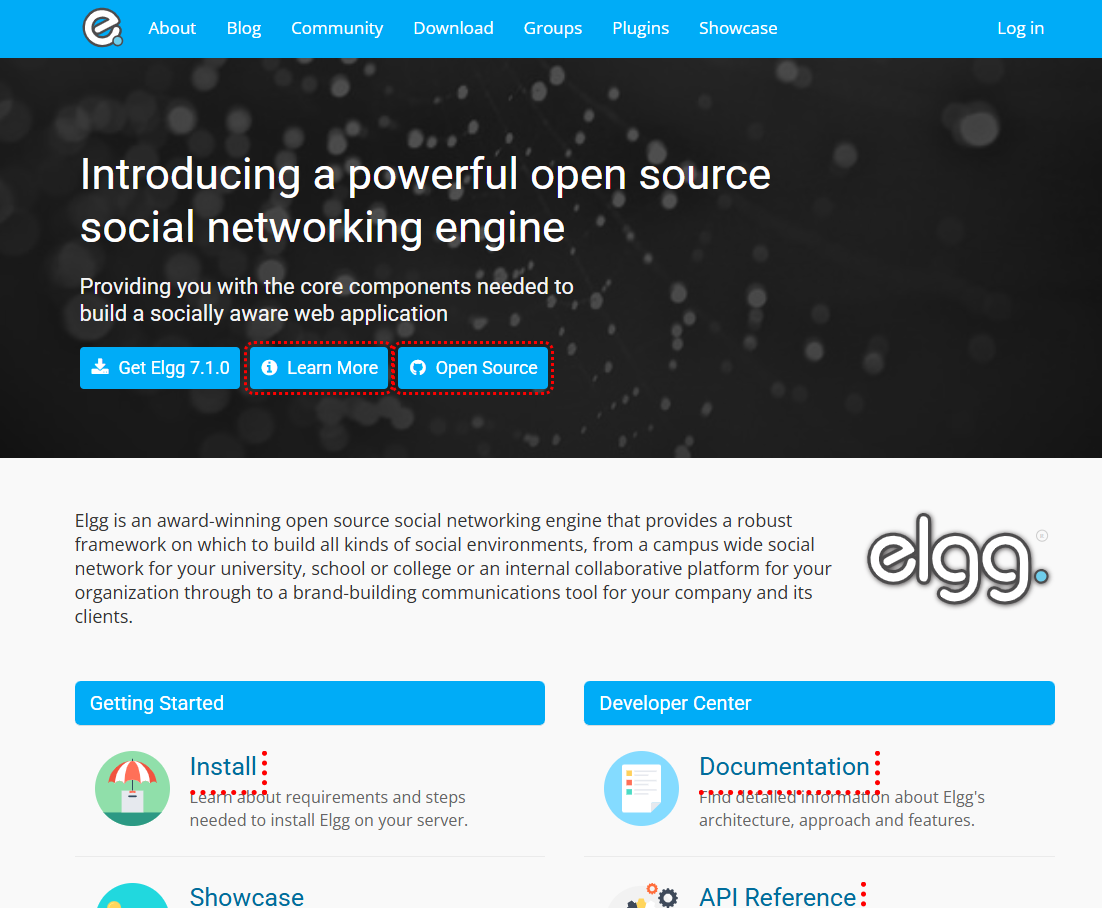
4. Elgg

Elgg is a long-running open-source social networking engine designed for developers and organizations that want to build customized social environments.

Unlike software that tries to be a ready-made copy of a particular social network, Elgg provides a framework and core components that can be adapted to different use cases.

The project is still actively maintained. Elgg’s official website currently lists version 7.1.0, released on September 10, 2026, as its latest stable release, with a 6.3.8 LTS release also available.

Elgg

Key features

  • User profiles
  • Activity streams
  • Social connections
  • Groups
  • Content sharing
  • Plugins
  • Custom themes
  • APIs
  • Authentication options
  • Developer-friendly architecture
  • Community extensions

Elgg is licensed under GPLv2, with some code available under MIT depending on the release configuration.

Its architecture is designed to be extended through plugins, themes, hooks, events, and APIs, making it particularly interesting for developers who want to create a customized community platform.

Who should use Elgg?

Elgg can be useful for:

  • Custom social networks
  • Educational communities
  • University networks
  • Company communities
  • Membership websites
  • Niche social platforms
  • Developer-led projects

If customization is more important to you than having a completely ready-made social network out of the box, Elgg is worth considering.

Website: elgg.org


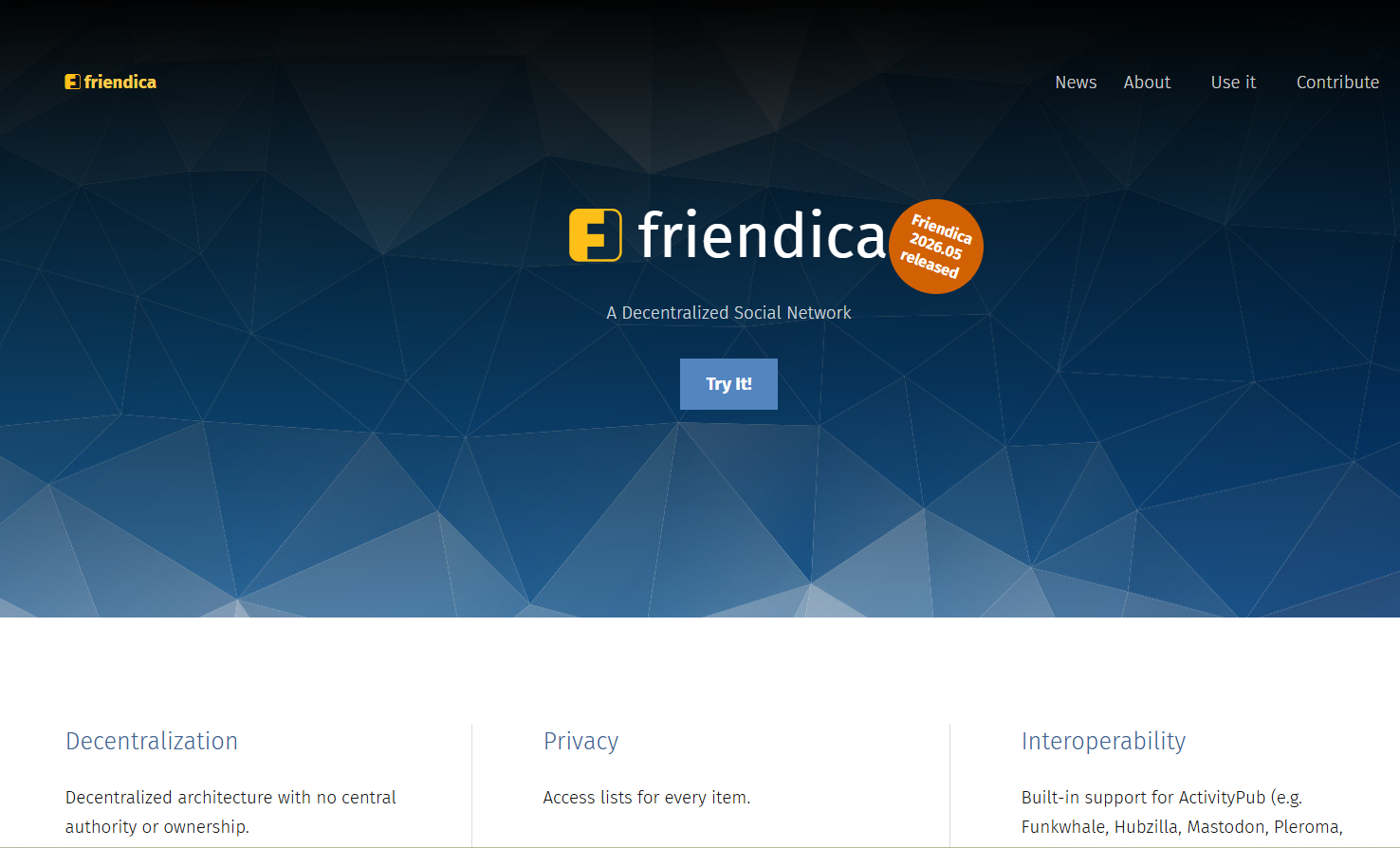
5. Friendica

Friendica takes a different approach from traditional social networking software.

It is a decentralized social networking platform designed to connect different social networks and services.

Friendica is part of the broader Fediverse and supports communication through protocols including ActivityPub. It can interact with platforms such as Mastodon, Lemmy, Diaspora, Pixelfed, PeerTube and others.

The software is free and open source under the AGPLv3-or-later license and can be installed on your own server using PHP and MySQL.

Friendica

Key features

  • Decentralized architecture
  • ActivityPub support
  • User profiles
  • Posts and comments
  • Social connections
  • Privacy controls
  • Cross-platform communication
  • Fediverse integration
  • Self-hosting
  • Add-ons and extensions

One of the interesting things about Friendica is that you don’t have to think of your community as an isolated website. Its interoperability allows users to communicate across compatible networks.

Who should use Friendica?

Friendica may be suitable for:

  • Decentralized social networks
  • Privacy-focused communities
  • Fediverse projects
  • Self-hosted social platforms
  • Developers interested in interoperability

Website: friendi.ca


Open-Source Social Networking Software Comparison

SoftwareBest ForSelf-HostedDecentralizedExtensible
MastodonFederated social networkYesYesYes
HumHubPrivate communities & intranetYesNoYes
BuddyPressWordPress communitiesYesNoYes
ElggCustom social networksYesNoYes
FriendicaFederated social networkingYesYesYes

These platforms aren’t direct substitutes for one another. Their architectures and intended use cases are different. For example, Mastodon and Friendica focus heavily on decentralized communication, while HumHub and BuddyPress are more suited to controlled communities or organization-based networks.

How to Choose the Right Open-Source Social Network Software

Before installing any platform, think about what you actually want to build.

For a decentralized social network

Look at Mastodon or Friendica.

These are designed around federated communication and the broader Fediverse.

For a company or private community

HumHub is worth considering because it is designed for social intranets, organizations, schools, associations, and private communities.

For a WordPress website

BuddyPress is the natural option to investigate because it extends WordPress with social networking functionality.

For a highly customized platform

Elgg provides a developer-oriented framework with plugins, themes, APIs, and extension points.

Things to Consider Before Self-Hosting

Installing open-source software is only the beginning.

If you’re planning to operate a real social network, you should also think about:

Hosting

A small community may work on modest hosting, but a growing social network can require considerably more CPU, RAM, storage, and database resources.

Security

You are responsible for keeping the software, server, plugins, themes, and dependencies updated.

Backups

User-generated content can become extremely valuable. Maintain regular database and file backups.

Moderation

A public social network needs tools and policies for handling spam, abuse, illegal content, impersonation, and other moderation issues.

Email

Registration, password resets, notifications, and other features may require properly configured transactional email.

Scaling

If your community grows, you may eventually need caching, CDN services, optimized databases, background jobs, object storage, and additional servers.


Can You Build Your Own Facebook-Like Website With Open-Source Software?

Yes, but it is important to understand what that means.

Open-source social networking software can provide the foundation for your platform, but you should not expect to install one of these projects and instantly have a complete replacement for Facebook.

Your final website may require:

  • Custom branding
  • UI/UX changes
  • Plugins or modules
  • Custom development
  • Mobile applications
  • Payment integration
  • Moderation tools
  • Analytics
  • Search
  • Notifications
  • Server infrastructure
  • Security configuration

The advantage is that you start with an existing foundation instead of developing every social networking feature from zero.

Final Thoughts

Open-source social networking has changed considerably since the early days of Facebook-style clone scripts.

Projects such as Mastodon and Friendica demonstrate the growing importance of decentralized and federated social networks, while HumHub, BuddyPress, and Elgg continue to provide different approaches for building communities, intranets, and customized social platforms.

The right choice depends less on finding a single “best” platform and more on deciding what type of community you want to build.

If you’re starting a WordPress-based community, BuddyPress can be a straightforward direction.

If you’re building an organization or private community, HumHub may fit the use case.

If you’re interested in the decentralized web, Mastodon or Friendica can be explored.

And if you’re a developer looking for a customizable social networking framework, Elgg remains an active open-source option.

The good news is that you no longer need to start a social networking project completely from scratch.

Top 5 Best Free YouTube Channel Name Generators in 2026

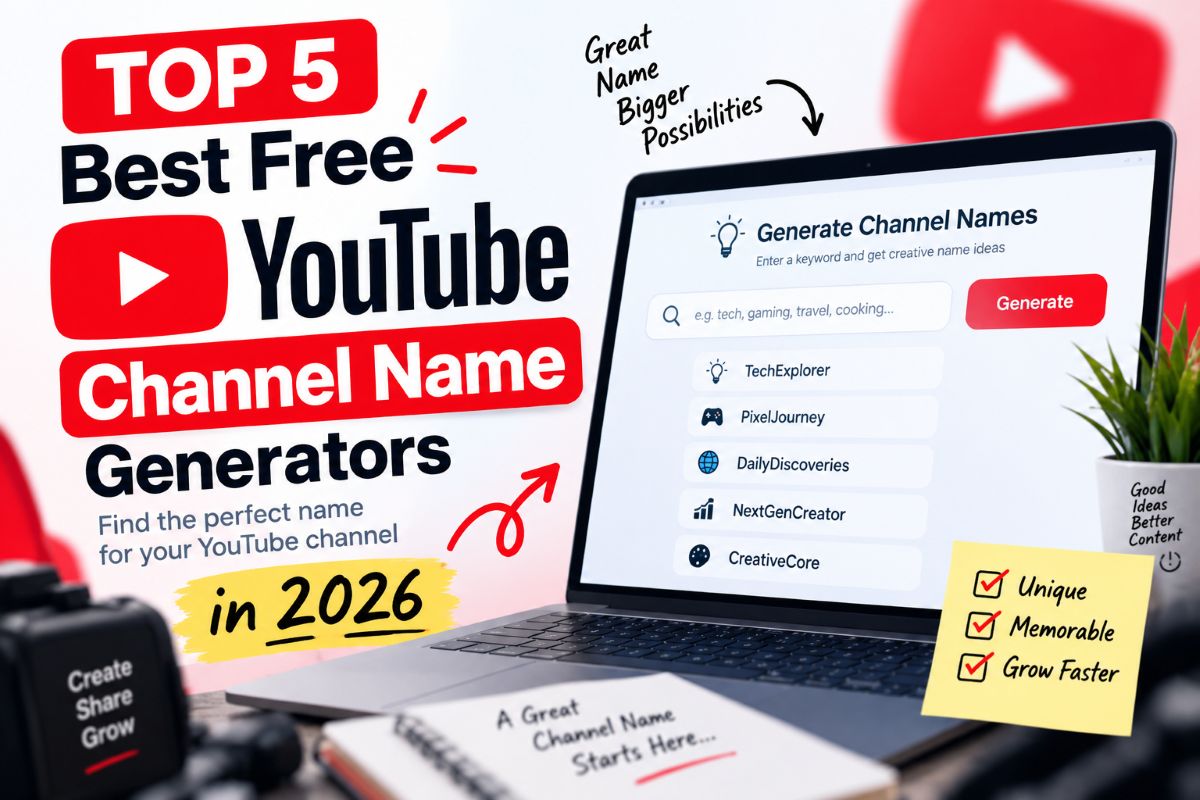
thumbnail design for article Top 5 Best Free YouTube Channel Name Generators

Coming up with a good name for a YouTube channel sounds easy until you actually sit down to choose one.

You type a few ideas, check them on YouTube, find that somebody is already using something similar, try another name, and suddenly an hour has disappeared.

A YouTube channel name doesn’t have to be complicated, but it should be easy to remember, easy to spell and suitable for the kind of content you plan to publish.

The good news is that you don’t have to come up with every idea yourself. There are several free YouTube channel name generators that can give you a starting point in just a few seconds.

I’ve collected five worth trying in 2026. Some are designed specifically for YouTube, while others are general-purpose naming tools that are useful when you want something more brandable.

What is a YouTube channel name generator?

A YouTube channel name generator is a simple online tool that creates name ideas based on information such as your niche, keywords, channel type or preferred style.

For example, if you’re starting a channel about:

  • Gaming
  • Technology
  • Fitness
  • Cooking
  • Travel
  • Education
  • Personal finance
  • AI
  • Vlogging

you can enter a few relevant words and let the generator come up with different combinations.

Don’t expect the first name it gives you to be perfect. Think of these tools as brainstorming assistants. The useful part is often finding a word combination or naming style you hadn’t considered yourself.

What makes a good YouTube channel name?

Before getting into the tools, there are a few things worth keeping in mind.

A good channel name should ideally be:

Easy to remember – Someone should be able to recall it after watching one of your videos.

Easy to spell – If people can’t spell it, finding your channel again becomes harder.

Relevant to your content – A name can give viewers an immediate idea of what your channel is about.

Short enough to use everywhere – If possible, choose something that also works well as a social media username.

Flexible – Don’t make the name so specific that you’re stuck with one type of video forever.

And most importantly, check the name before you commit to it. A generator can suggest a name, but it cannot guarantee that the name is available or that nobody else is using a similar brand.

5 Best Free YouTube Channel Name Generators

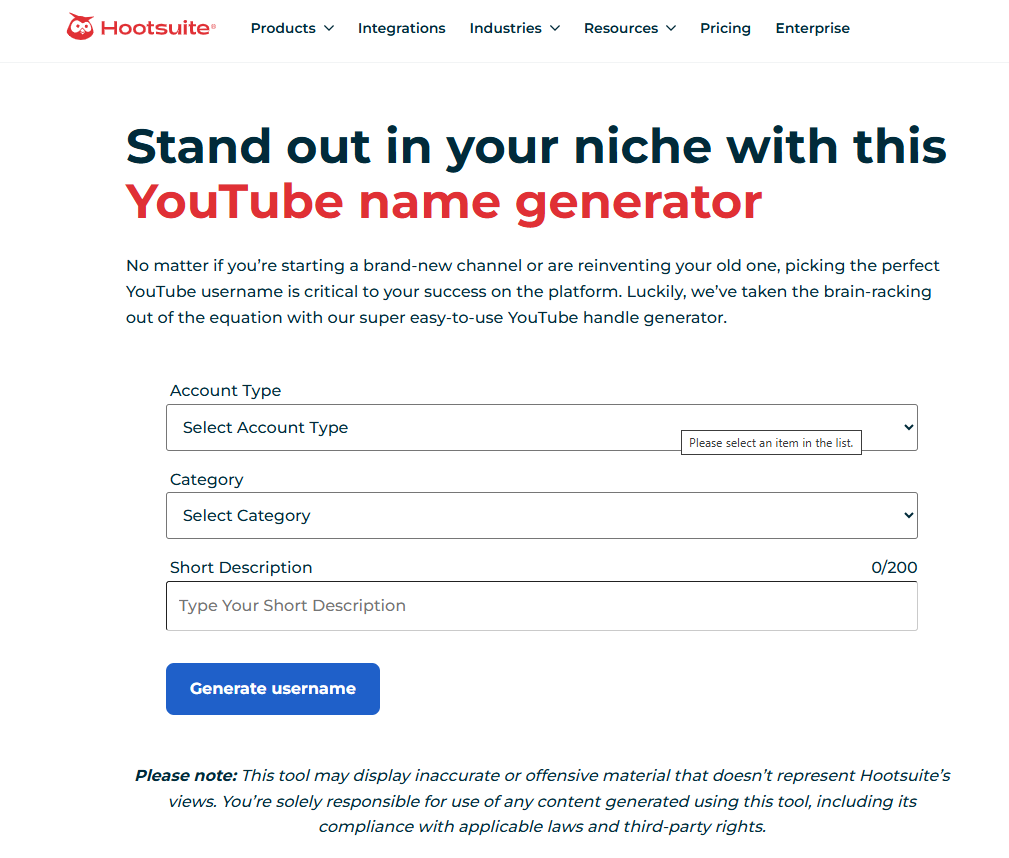
1. Hootsuite YouTube Name Generator

Hootsuite YouTube Name Generator

youtube name generator hootsuite

If you want a tool specifically built around YouTube usernames, Hootsuite’s generator is a good place to start.

Instead of simply throwing random words together, it asks for information such as your account type, category and a short description of your channel. It then generates username ideas based on what you provide.

I particularly like the fact that it encourages you to think about your niche before generating names. That’s useful because a name based on your actual content usually makes more sense than a completely random combination of words.

Good for:

  • New YouTube creators
  • Niche channels
  • Business channels
  • Personal brands
  • Quick username ideas

My tip

Don’t enter just one keyword such as “gaming.” Give the generator some context. Something like “mobile gaming reviews for casual players” gives you a much better starting point.


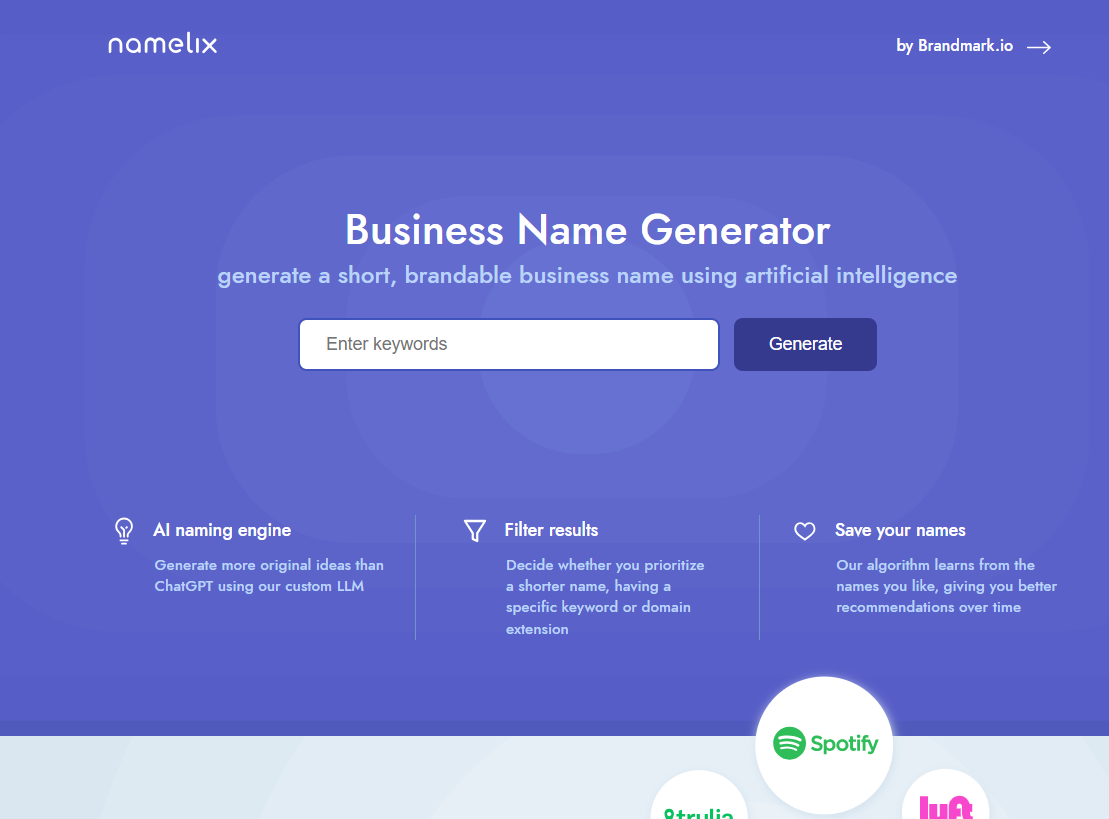
2. Namelix

Namelix Business Name Generator

YouTube Channel Name Generators

Namelix isn’t exclusively a YouTube tool, but it’s one of the better options if you want a name that could eventually become a proper brand.

You enter keywords describing your idea and Namelix generates short, brandable names. You can also adjust preferences around things such as name length and keywords. The tool can learn from the names you save and use those preferences for later suggestions.

This makes it particularly interesting for creators who don’t want a name that sounds like a typical YouTube channel.

For example, instead of something like:

Best Tech Reviews 2026

you might want a shorter brand-style name that could later be used for a website, newsletter, social media account or even a product.

Good for:

  • Tech channels
  • Startups
  • Personal brands
  • Business channels
  • Creators planning to build a larger brand

My tip

If you think your YouTube channel could eventually become a website or business, try Namelix instead of limiting yourself to a purely descriptive YouTube name.


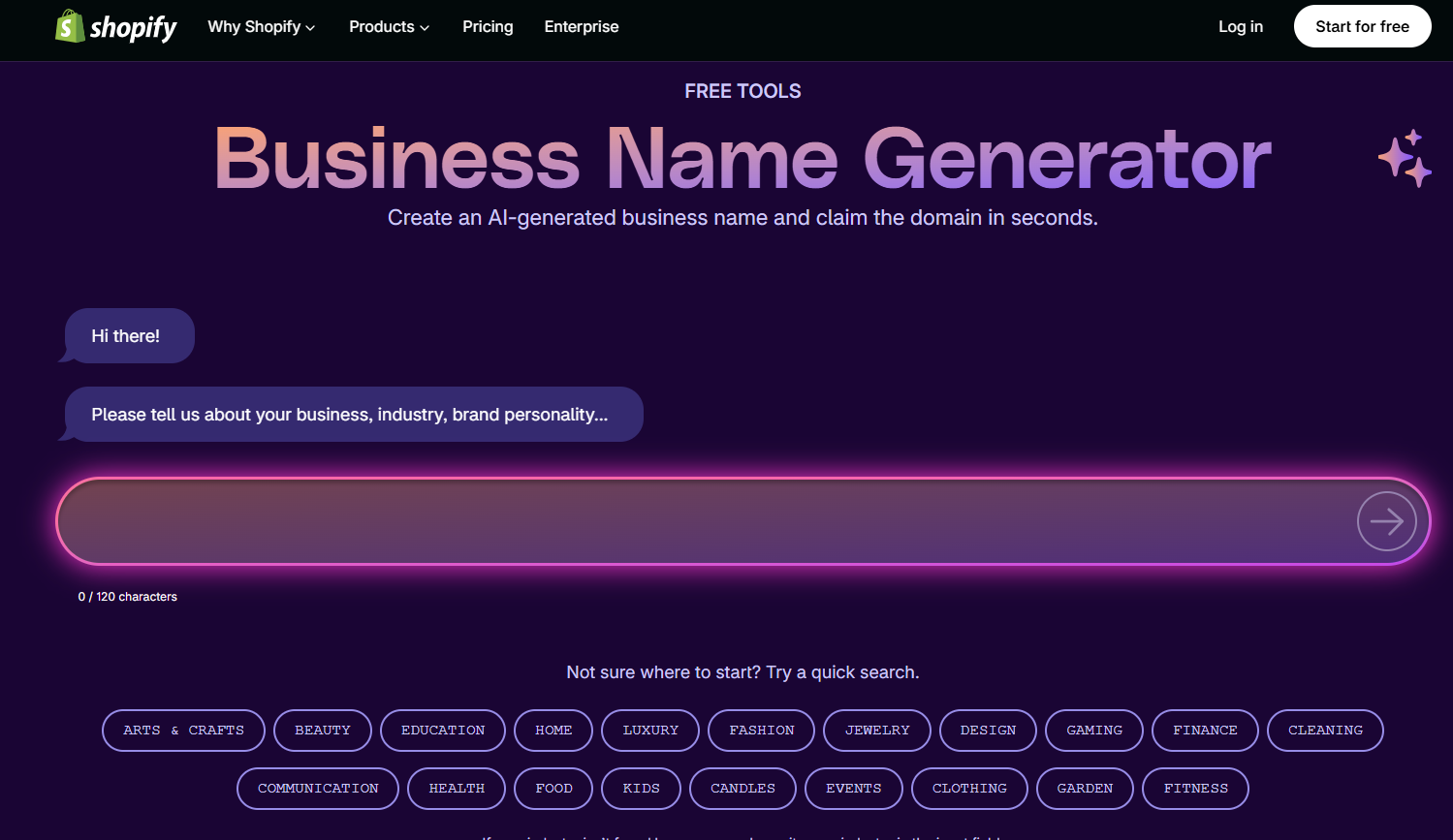
3. Shopify Business Name Generator

Shopify Business Name Generator

YouTube Channel Name Generators shopify

Here’s another tool that isn’t specifically made for YouTube, but it can be surprisingly useful.

Shopify’s free business name generator lets you describe your business or idea and generates potential brand names. It also focuses on domain availability as part of its naming workflow.

Why use a business name generator for YouTube?

Because sometimes you don’t actually want a “YouTube name.” You want a brand.

If you’re planning a channel around a business, product reviews, education, technology or entrepreneurship, thinking like a brand owner can produce better long-term options.

Good for:

  • Business YouTube channels
  • E-commerce creators
  • Entrepreneur channels
  • Educational brands
  • Channels that will also have a website

My tip

Try entering a short description of your channel rather than just a single keyword. Experiment with different descriptions and compare the results.


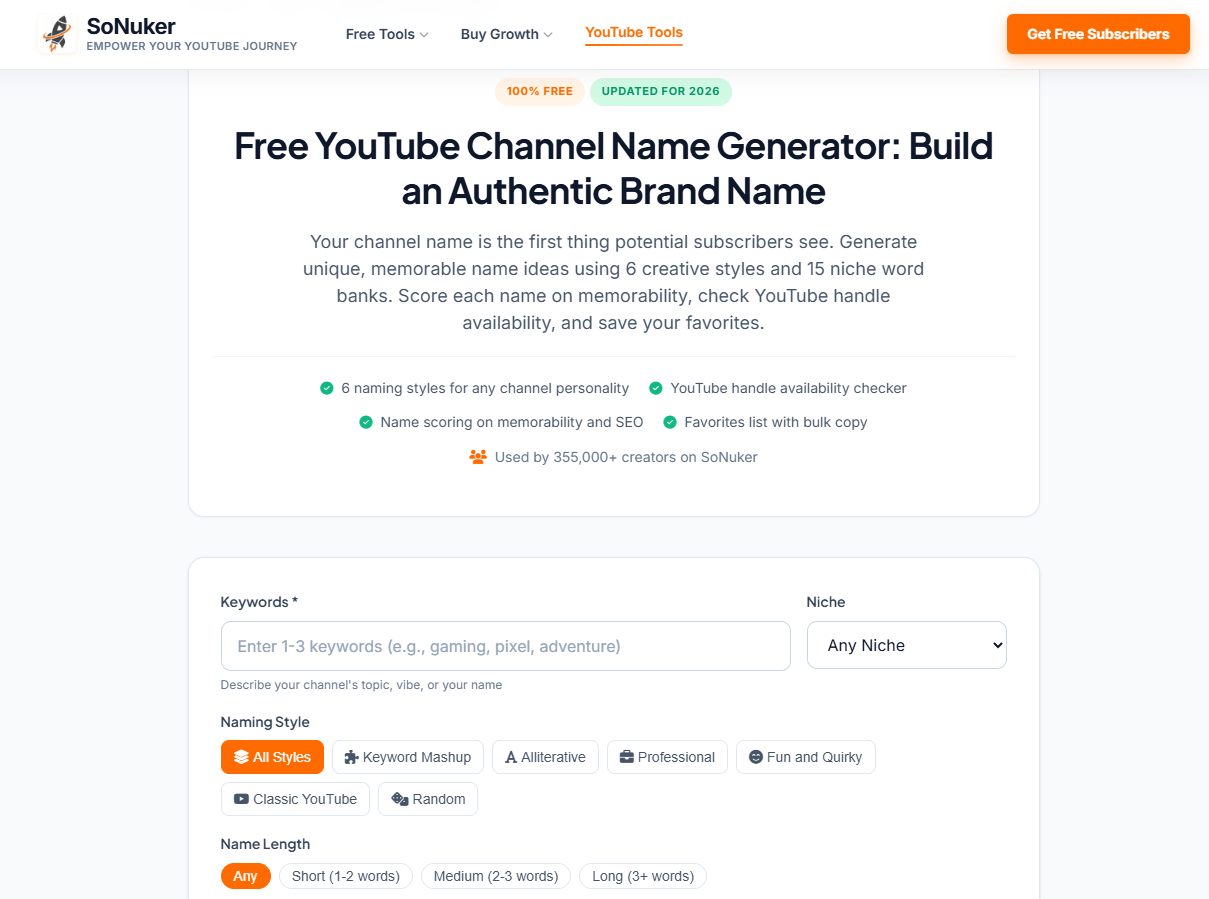
4. SoNuker YouTube Channel Name Generator

SoNuker YouTube Channel Name Generator

YouTube Channel Name Generators sonuker

SoNuker’s tool is more focused on YouTube naming and offers several options for shaping the results.

You can enter keywords, describe your channel, select a niche and choose different naming styles. The tool also provides options around name length and offers features such as name scoring and handle checking.

The style options are useful if you’re not sure what kind of personality your channel should have.

For example, a gaming channel and a professional finance channel probably shouldn’t sound the same.

Good for:

  • Gaming channels
  • Vlogs
  • Educational channels
  • Personal brands
  • Creators who want different naming styles

My tip

Generate several batches instead of choosing from the first list. Sometimes the better ideas appear after you’ve changed the naming style or keywords.


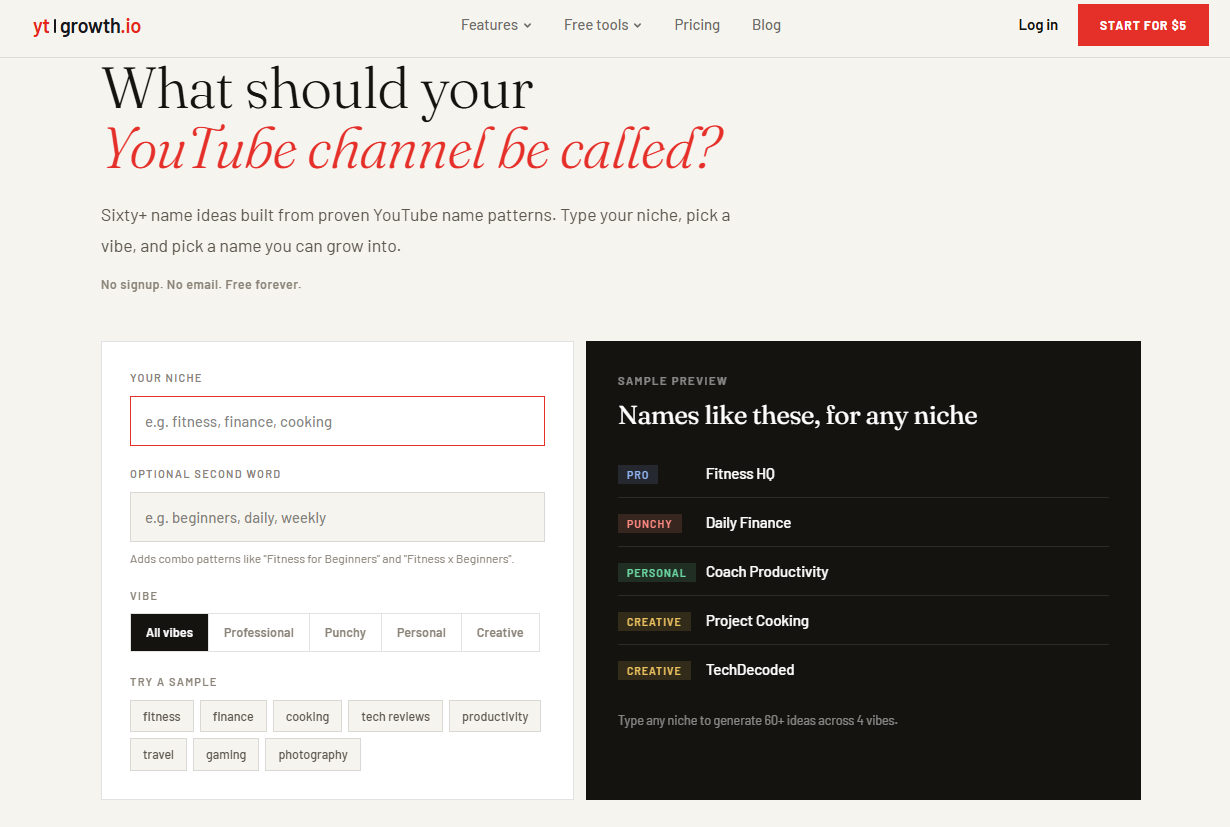
5. YouTube Name Generator by YTGrowth

YTGrowth YouTube Channel Name Generator

YouTube Channel Name Generators ytgrowth

YTGrowth takes a fairly straightforward approach.

You enter your niche, optionally add another keyword and choose the kind of personality you want for the name, such as professional, punchy, personal or creative. The tool then produces a larger set of ideas.

I like this type of generator when you’re still at the brainstorming stage and don’t have a particular name in mind.

For example, you could try: photography + travel then: photography + stories, and finally: photography + daily

You may end up with completely different naming directions from the same basic idea.

Good for:

  • Beginners
  • Vloggers
  • Niche channels
  • Personal channels
  • Brainstorming lots of ideas quickly

Quick Comparison

ToolBest ForYouTube FocusFree
HootsuiteYouTube usernamesHighYes
NamelixBrandable namesLowYes
ShopifyBusiness/brand namesLowYes
SoNukerYouTube creatorsHighYes
YTGrowthQuick brainstormingHighYes

The “best” tool really depends on what you’re trying to create. If you want a straightforward YouTube username, start with a YouTube-focused generator. If you’re building a brand that may eventually exist outside YouTube, a business or brand name generator can give you more interesting directions.

How to Choose the Right Name From the Suggestions

This is probably more important than the generator you use.

You might generate 50 or even 100 names and still not find one you love. That’s normal.

Once you have a list, narrow it down using these checks.

1. Say it out loud

Does it sound natural when you say:

“Welcome back to [Channel Name].”

If it feels awkward, remove it from the list.

2. Check the spelling

Ask a friend to write the name down after hearing it.

If they immediately spell it differently, that’s a warning sign.

3. Search YouTube

Search the exact name and a few close variations.

You don’t want to build a brand around a name that’s already strongly associated with another creator.

4. Check the @handle

Your channel name and YouTube handle aren’t exactly the same thing.

YouTube handles use the @ format and act as a unique identifier for channels, so check the handle before making a final decision.

Don’t assume that a generator saying a name looks available means you can definitely claim it. Confirm the final choice through YouTube.

5. Check social media

If you plan to promote your videos on Instagram, Facebook, X or other platforms, search for the same username there.

You don’t necessarily need the exact same username everywhere, but having a consistent brand makes life easier.

6. Think five years ahead

This is the check people often forget.

If you’re starting a gaming channel today, you might be tempted to choose something extremely specific to one game.

But what happens if you start making videos about other games next year?

A slightly broader name may give you more room to grow.

Should You Put Your Keyword in Your YouTube Channel Name?

Not necessarily.

A keyword can make it obvious what your channel is about, but you don’t need to force a keyword into the name just because you’re worried about SEO.

For example, a photography channel doesn’t necessarily need a name containing the word “photography.”

A memorable brand can work just as well in the long run.

The important thing is that your channel’s content, titles, descriptions and overall branding clearly communicate what you offer.

Don’t Let the Generator Make the Final Decision

This is probably the biggest thing I’d recommend.

A name generator is there to give you ideas. It doesn’t know your audience, your personality or what you eventually want to do with the channel.

So don’t simply copy the first result that sounds okay.

Generate a bunch of options, shortlist five or ten, search them, check the handles and then choose the one that feels natural to you.

Sometimes the best channel name isn’t the cleverest one. It’s simply the one you can imagine still using several years from now.

Final Thoughts

There are plenty of free YouTube channel name generators available in 2026, and they’re useful when you’re staring at a blank screen and can’t think of anything.

My approach would be simple: use one or two generators to get ideas, shortlist the names that actually sound good, and then do your own availability and brand checks before committing.

And don’t spend days trying to find a “perfect” name. Your videos, consistency and the audience you build will ultimately give the name its meaning.

Start with a good name. Then put your energy into making a channel people want to come back to.

Best Ways to Increase Website Traffic in 2026: 15 Proven Methods

 website traffic
Best Ways to Increase

Getting people to visit a new website is harder than simply publishing a few articles and waiting for Google to notice.

I’ve seen this happen quite often. A website can have a good design, useful information and dozens of published pages, yet the traffic stays surprisingly low. The problem usually isn’t the website itself. It’s that nobody has discovered it yet.

The good news is that there are still plenty of ways to get website traffic in 2026. The difference is that traffic now comes from many different places—not just Google.

Search engines, AI-powered search, YouTube, social networks, online communities, email, referrals and even old articles can all bring visitors to your site.

The trick is not to try everything at once.

Instead, pick a few channels that make sense for your audience, work on them consistently and pay attention to where your visitors actually come from.

Here are some of the methods I’d focus on.

1. Start With SEO

SEO is still one of the most useful long-term traffic sources for a website.

The basic idea hasn’t changed: create something useful, make sure search engines can understand it, and target topics that people are actually searching for.

But SEO in 2026 is much more than putting a keyword into an article ten times.

Before writing anything, ask:

  • What is the person actually trying to find?
  • Can I answer the question better than the existing results?
  • Can I provide an example, screenshot, comparison or experience that other pages don’t have?
  • Is this article genuinely useful if someone lands on it from Google?

For example, instead of writing an article called:

“Best Hosting Providers”

you could create something more useful:

“I Tested 5 Hosting Providers for WordPress: Which One Makes Sense for a Small Website?”

The second approach gives you room to share actual observations, screenshots, pricing, performance information and practical recommendations.

That’s the type of content people are more likely to read and remember.

2. Don’t Ignore AI Search

Search is changing.

People increasingly ask questions through AI-powered search experiences as well as traditional search engines. Google itself now provides guidance for websites appearing in AI Overviews and AI Mode.

That doesn’t mean you need some secret “AI SEO trick.”

In fact, the basics are still important.

Make your content easy to understand. Answer questions clearly. Use descriptive headings. Provide useful examples. Keep important information on the actual page rather than hiding everything behind unnecessary scripts or downloads.

Most importantly, give the reader something worth visiting your website for.

For example, if you’re writing about a software tool, don’t simply repeat the manufacturer’s feature list.

Show how you used it.

Explain what worked.

Mention limitations.

Add screenshots.

Compare it with alternatives.

That’s much more useful than another 1,500-word generic summary.

3. Write for Topics, Not Just Keywords

One of the biggest mistakes beginners make is creating one article for every slightly different keyword.

You don’t necessarily need:

  • Best SEO tools
  • Top SEO tools
  • SEO tools for beginners
  • Best tools for SEO
  • Free SEO tools
  • SEO tools online

as six completely separate articles.

Instead, you could create one genuinely useful guide covering the topic and its important subtopics.

Then create supporting articles when there is a good reason to do so.

For example:

Main guide:
Best SEO Tools for Small Websites

Supporting articles:

  • How to Find Long-Tail Keywords
  • How to Check Google Search Console Data
  • How to Find Broken Links
  • How to Track Organic Traffic

Link these pages together naturally.

This gives readers a path through your website instead of leaving every article as an isolated page.

4. Update Your Old Articles

This is one of the easiest traffic opportunities if your website already has an archive.

You don’t always need to publish another new article.

Look at your existing posts and find pages that:

  • used to receive traffic
  • have outdated information
  • rank on the second page of Google
  • have declining clicks
  • contain old screenshots
  • mention old software versions
  • have outdated statistics or examples

Then improve them.

Don’t just change the publication date.

Actually update the article.

Add new information, remove outdated sections, improve examples, add internal links and rewrite weak paragraphs.

For a site that has been publishing for years, this can be far more productive than constantly starting from zero.

5. Build Content Around Real Problems

Some of the best traffic opportunities come from questions people ask when something has gone wrong.

Think about the problems your audience faces.

For a WordPress audience, that could be:

  • WordPress website is slow
  • Images are too large
  • Contact form isn’t sending emails
  • Website shows a 500 error
  • Google isn’t indexing a page
  • SSL certificate isn’t working

For an Android developer:

  • app crashes on startup
  • Gradle build fails
  • Play Store rejects an update
  • Java version is incompatible
  • app takes too long to launch

These aren’t just keywords.

They’re problems.

If your article actually solves the problem, the visitor has a reason to stay.

6. Use YouTube and Short Videos

You don’t need to become a full-time YouTuber.

Even short videos can support your website.

Suppose you’ve written:

How to Set Up WordPress on a VPS

You could create a 5–10 minute video showing the process.

Then:

  • embed the video in the article
  • publish it on YouTube
  • create a short clip from it
  • share the clip on social media
  • link back to the detailed tutorial

One piece of work can become several pieces of content.

This works particularly well for tutorials because people often prefer seeing a process rather than reading every step.

7. Use Social Media as a Distribution Channel

Publishing an article doesn’t automatically mean people will see it.

After publishing, give it some distribution.

Depending on your audience, that might mean:

  • Facebook
  • Instagram
  • LinkedIn
  • X
  • Threads
  • Reddit
  • YouTube
  • relevant communities

But don’t simply post:

“New article published. Read here: [link]”

That rarely gives people a reason to click.

Instead, take one useful part of your article and turn it into a post.

For example:

5 things I learned after moving a WordPress site to a VPS

Then explain the five things.

At the end, mention that you’ve written a detailed guide for anyone who wants the complete process.

The social post becomes useful on its own.

8. Participate in Online Communities

Communities can send surprisingly good traffic when you actually participate instead of treating them like advertising platforms.

Find places where your target readers already ask questions.

That could be:

  • Reddit communities
  • Facebook groups
  • developer communities
  • niche forums
  • Discord communities
  • industry groups

Don’t join a community and immediately drop links to your website.

Answer questions.

Share your experience.

Help people.

If you have a detailed article that genuinely answers someone’s question, then link to it where appropriate.

A useful answer can continue sending visitors long after you post it.

9. Build an Email List

Don’t assume email is outdated.

A visitor who reads one article and disappears is difficult to reach again.

Someone who subscribes to your newsletter is different.

You have permission to contact them again.

Your newsletter doesn’t need to be complicated.

For a technology website, it could simply include:

This week’s useful reads

  • 3 interesting AI tools
  • 2 useful tutorials
  • 1 new software recommendation
  • 1 interesting technology story

The important part is consistency.

You don’t need to send an email every day.

Even once a week can be enough if the content is worth opening.

10. Use Internal Links Properly

Internal linking is one of the simplest things you can improve on an existing website.

When writing a new article, look for older articles that genuinely help explain the topic.

Then link to them.

For example:

If you’re writing about website traffic, you might naturally link to articles about:

  • SEO
  • keyword research
  • Google Search Console
  • content marketing
  • WordPress
  • website speed

Don’t add links just to increase the number of links.

Add them because the reader might want more information.

Good internal linking helps visitors discover more of your website and makes your older content useful again.

11. Get Traffic From Other Websites

Referral traffic is often overlooked.

Suppose another website publishes an article about starting a blog and links to your detailed WordPress tutorial.

Some of its readers may click that link and visit your site.

That is referral traffic.

You can earn these opportunities by:

  • creating genuinely useful resources
  • publishing original research
  • contributing expert comments
  • writing guest articles where appropriate
  • creating tools or calculators
  • publishing useful statistics
  • building relationships with people in your industry

Don’t chase hundreds of random backlinks.

One relevant link from a website whose readers actually care about your subject can be more useful than dozens of unrelated links.

12. Create Something People Can Actually Use

If you want your website to stand out, create resources rather than only articles.

For example:

  • calculators
  • checklists
  • templates
  • downloadable guides
  • comparison tables
  • prompt libraries
  • free tools
  • WordPress snippets
  • SEO checklists
  • useful spreadsheets

These pages can attract search traffic, social shares and natural links.

A useful tool can also become a reason for people to come back to your website.

13. Don’t Forget Pinterest, Images and Visual Search

Depending on your topic, images can be another source of visitors.

Create useful original graphics for:

  • tutorials
  • checklists
  • comparisons
  • how-to guides
  • statistics
  • infographics

Use descriptive filenames and alt text, but don’t stuff keywords into them.

A good image should help the reader—not simply exist because an SEO plugin says an image is required.

14. Try Paid Advertising When It Makes Financial Sense

Organic traffic takes time.

If you have a product, service, course or affiliate offer that converts well, paid advertising can be useful.

You could test:

  • Google Ads
  • Meta Ads
  • YouTube Ads
  • LinkedIn Ads
  • other niche advertising platforms

But don’t start spending money just because you want more visitors.

First work out what a visitor is worth.

For example, if you’re spending ₹10,000 on advertising and generating ₹4,000 in revenue, more traffic isn’t fixing the problem.

You need to improve the offer, landing page, conversion rate or targeting first.

15. Measure Where Your Visitors Are Actually Coming From

This is probably the most important part.

Don’t guess.

Use tools such as Google Search Console and Google Analytics to understand what’s happening.

Look at:

  • impressions
  • clicks
  • search queries
  • pages receiving traffic
  • countries
  • devices
  • referral sources
  • engagement
  • conversions

You may discover something interesting.

Perhaps you thought Google was your main traffic source, but YouTube is actually bringing visitors who spend much more time on your site.

Or perhaps one old article generates more traffic than 20 new posts combined.

Your analytics should influence what you work on next.

So, What Is the Best Way to Get Website Traffic?

There isn’t one magic traffic source.

For most websites, I’d think about traffic as a combination of several channels:

SEO → long-term organic traffic

Useful content → attracts people searching for answers

AI search visibility → another way people may discover your content

YouTube & social media → content distribution

Communities → targeted visitors and relationships

Email → repeat visitors

Referrals & backlinks → authority and new audiences

Paid advertising → faster testing and targeted acquisition

The right combination depends on your website and your audience.

If you’re starting from scratch, I wouldn’t try all 15 methods at the same time.

I’d start with three.

For example:

Month 1

Create useful content around problems your audience actually has.

Month 2

Improve SEO, internal linking and older articles.

Month 3

Start distributing your content through video, social media or communities.

Then look at the numbers and decide where to spend more time.

One Last Thing: Don’t Chase Traffic Just for the Numbers

A website getting 100,000 visitors isn’t necessarily more successful than one getting 10,000.

It depends on who those visitors are and what they do after arriving.

If 10,000 visitors are genuinely interested in your topic, they may be much more valuable than 100,000 people who clicked a misleading headline and immediately left.

So instead of asking:

“How can I get more website traffic?”

try asking:

“How can I get more of the right people to visit my website?”

That’s a much better question.

And in 2026, with search becoming more competitive and people discovering information through more platforms than ever, creating something genuinely useful is still one of the safest long-term traffic strategies you can build around.

10 Real SEO Tips to Increase Traffic Today in 2026

If you’ve spent any time reading beginner SEO advice lately, you’ve probably noticed a lot of it feels stuck in a time loop.

“Put your keyword in the title tag. Write a meta description under 160 characters. Submit your XML sitemap.”

Sure, those technical basics still matter—in the same way having wheels matters for a car. But they aren’t going to win you races anymore. Search engines don’t just count keyword frequency; they look for search intent, genuine human experience, topical depth, and brand credibility.

Whether you’re starting a new niche site or trying to revive a blog that stalled out, here are the 10 SEO fundamentals that actually move the needle right now.

1. Solve Intent, Don’t Just Match Words

A keyword isn’t a magic phrase; it’s an unsolved problem.

Before typing a single word, search your target phrase in incognito mode and study what Google is already ranking:

  • Are people looking for a quick definition?
  • Do they want a step-by-step tutorial?
  • Are they comparing tools before buying?

If someone searches “best running shoes for flat feet” and you spend 800 words explaining what a arch is, they will hit the back button in three seconds. When readers bounce immediately, search engines learn your post didn’t solve the problem. Give readers the answer first, then provide the context.

2. Double Down on Real Experience (Google’s E-E-A-T)

The web is flooded with generic, synthesized content. Search engines actively prioritize original insight, hands-on testing, and personal perspective (Experience, Expertise, Authoritativeness, and Trustworthiness).

Inject what generic copy can’t replicate:

  • Real screenshots or photos you took yourself.
  • Specific numbers, case studies, or anecdotes (“When I tested tool X, here’s what broke…”).
  • Clear author bios showing who wrote the piece and why they know what they’re talking about.

3. Build Topic Clusters Instead of Random One-Offs

Publishing ten unrelated blog posts across ten random topics won’t build authority. Search engines want to see that your site is a legitimate resource on a focused subject.

Organize your content using pillar and cluster models:

  • Pillar: An ultimate guide (e.g., The Complete Guide to Remote Freelancing).
  • Clusters: In-depth sub-articles (e.g., How to Invoice Clients, Best Time-Tracking Software, Setting Up a Home Office).
  • Interlinking: Link every cluster post back to the main pillar, and link related sub-articles together naturally.

4. Optimize for “Information Gain”

If your post just repeats the same five points as the top three results on Page 1, Google has zero reason to rank you above them.

Always ask yourself: What is the information gain of this post?

  • What did the top ranking pages miss?
  • What common myth can you debunk?
  • Can you add an original checklist, a helpful calculation, or a graphic that makes the concept clearer?

If you don’t add anything new to the web, you’re competing solely on domain age and backlinks—a battle small blogs rarely win.

5. Format for Humans Who Skim (And AI That Scrapes)

Most visitors scan before they read. If your post looks like an endless wall of text, they’ll leave.

Structure your articles so both humans and search engines can parse them effortlessly:

  • Use clear H2 and H3 tags that describe what follows.
  • Keep paragraphs to 2–3 sentences max.
  • Use bold text for key takeaways.
  • Include comparison tables and bulleted lists for structured data. Clear, concise summaries frequently get pulled into featured snippets and AI overviews.

6. Keep Internal Links Intentional and Contextual

Internal linking is one of the most underrated SEO levers because you have 100% control over it.

Don’t just stick links in the footer or sidebar. Link inside body paragraphs using descriptive anchor text. If you mention budgeting for a new dog, link directly to your puppy budget breakdown on those exact words. It passes page authority, keeps visitors on your site longer, and tells search crawlers how your topics connect.

7. Prioritize Core Web Vitals and Mobile Reality

More than 60% of search traffic is on mobile. If your site takes four seconds to load on a 4G connection or shifts around while loading ad banners, your rankings will suffer.

Keep performance clean:

  • Run your key pages through Google PageSpeed Insights.
  • Compress all images (convert PNGs/JPEGs to WebP).
  • Strip out unused plugins, bulky scripts, and pop-ups that block the viewport on mobile devices.

8. Optimize for Brand Mentions and Real Community Signals

Old-school link building—like posting links in blog comments or shady directory submissions—is dead and can actively trigger algorithmic penalties.

Modern link acquisition comes from visibility and genuine connection:

  • Share practical takeaways on LinkedIn, Reddit, or X where your target audience hangs out.
  • Collaborate with other creators in your niche (podcast guesting, co-marketing, quotes).
  • Publish original data or surveys that other writers naturally want to cite as a source.

9. Target Low-Competition, Long-Tail Queries First

If your blog is relatively new, trying to rank for “keto diet” or “best credit cards” is a recipe for burnout. The first page is dominated by multi-million-dollar media companies.

Instead, find long-tail questions with genuine buyer or search intent:

  • Instead of “best camera,” target “best budget video camera for cooking tutorials.”
  • Look at community forums like Reddit, Quora, and Google’s “People Also Ask” box to see how real people phrase their questions.

Once you build steady traffic and authority across dozens of specific posts, you can gradually tackle higher-competition keywords.

10. Audit and Refresh Your Content Regularly

SEO isn’t a “publish and forget” game. Over time, links break, stats become obsolete, and competitors write more comprehensive updates.

Every six months:

  • Check your analytics for posts that are losing traffic.
  • Update outdated tools, pricing, and years.
  • Add new sections addressing recently asked questions.
  • Prune or redirect thin posts that aren’t getting impressions.

Refreshing an existing post that already has some authority often yields results much faster than writing an article from scratch.

The Bottom Line

Search engines have gotten much smarter, but their ultimate goal hasn’t changed: reward the page that best satisfies the searcher. If you focus on creating genuine, fast, and structured answers that respect the reader’s time, you won’t need to chase every minor algorithm tweak.