


Creating content sounds easy until you actually have to do it.
One day you’re writing a blog post, the next you’re editing a video, creating a thumbnail, replying to comments, preparing social media posts, and trying to come up with the next great idea. Before you know it, most of your time is spent on small tasks instead of actually creating.
This is where AI tools can make a real difference.
AI isn’t going to replace creativity, but it can take care of a lot of repetitive work. From writing and research to image creation, video editing, and audio production, there are now tools that can save creators hours every week.
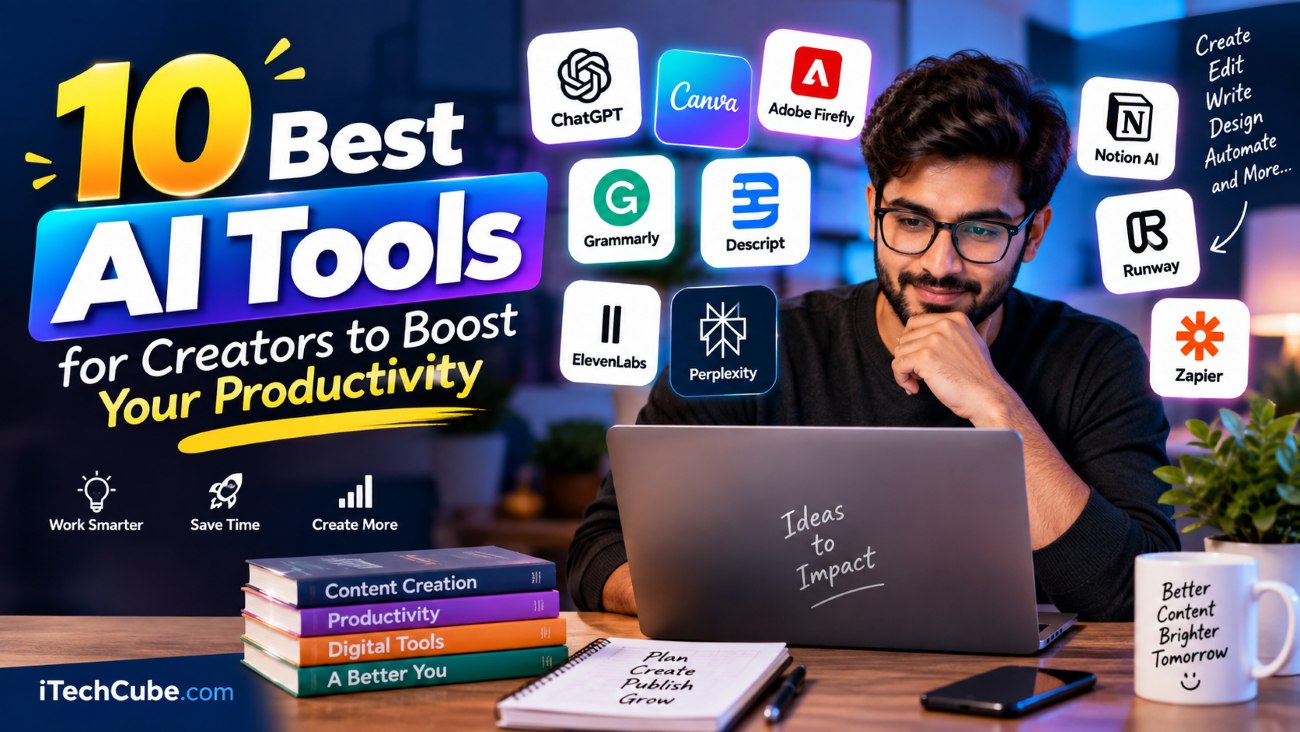
I’ve put together 10 AI tools that are particularly useful for creators. You don’t necessarily need all of them. In fact, finding two or three that fit your workflow is usually more useful than signing up for every AI tool you come across.
Best AI Tools for Creators
1. ChatGPT – For Ideas, Writing and Research
OpenAI’s ChatGPT is probably one of the most versatile AI tools available to creators.
You can use it to brainstorm blog topics, create content outlines, rewrite paragraphs, generate social media ideas, summarize information, write video scripts, create email drafts, or even help with coding and technical tasks.
The important thing is not to simply ask it to “write an article.” The better results usually come when you give it context, explain your audience, and tell it what kind of content you’re trying to create.
Best for: Bloggers, writers, marketers, YouTubers, developers
My take: Think of ChatGPT more like a creative assistant than a replacement for your own writing.
2. Canva – Create Designs Without Being a Designer
Canva has become a go-to tool for creators who need to produce graphics quickly.
Its AI-powered features can help with things like generating design ideas, creating images, writing copy, resizing designs, and editing existing graphics.
It’s particularly handy when you need several versions of the same content. For example, you might create a YouTube thumbnail and then need versions for Instagram, Facebook, and your website.
Instead of starting everything from scratch, Canva can speed up much of that process.
Best for: Social media creators, bloggers, marketers, small businesses
3. Adobe Firefly – AI Image and Creative Generation
If you regularly work with images, Adobe Firefly is worth checking out.
Firefly can generate images from text prompts and is also integrated into Adobe’s wider creative ecosystem. This makes it useful for creators who already use Photoshop or other Adobe applications.
For example, you can generate a background for a thumbnail, remove unwanted elements from an image, or experiment with different visual concepts before creating the final design.
It’s especially useful during the early stages of a project when you’re trying to turn an idea into something visual.
Best for: Designers, photographers, marketers, content creators
4. Grammarly – Improve Your Writing
Not every creator needs AI to write an entire article. Sometimes you just need someone to catch the awkward sentence you somehow didn’t notice after reading it five times.
That’s where Grammarly can help.
It can check grammar, spelling, clarity, tone, and other aspects of your writing. Its AI features can also help rewrite text or adjust the tone depending on what you’re trying to communicate.
For bloggers and people who write emails, social posts, proposals, or business content regularly, this can be a useful final check before publishing.
Best for: Bloggers, writers, students, professionals
5. Descript – Edit Videos by Editing Text
Video editing can take a surprising amount of time, especially when you’re working with talking-head videos, tutorials, podcasts, or interviews.
Descript takes a slightly different approach. It transcribes your video and allows you to edit the recording by editing the transcript.
That means you can remove a sentence from the transcript and have it removed from the video as well.
Descript also includes AI features for things like removing filler words, improving audio, and creating clips from longer recordings.
Best for: YouTubers, podcasters, educators, video creators
6. ElevenLabs – AI Voice and Audio
Audio is another area where AI has become surprisingly useful.
ElevenLabs provides AI voice and audio tools that can be used for voiceovers, narration, dubbing, and other creative projects.
For creators who don’t want to record their own voice for every video, AI voice generation can be a practical option. It’s also useful when producing content in multiple languages.
Of course, the voice you choose matters. A robotic or obviously artificial voice can make otherwise good content feel cheap, so it’s worth spending some time finding a natural-sounding option.
Best for: YouTubers, video creators, podcasters, audiobook creators
7. Perplexity – Faster Research
Research is one of those parts of content creation that can quietly eat up hours.
Perplexity is designed around AI-powered search and research. Instead of opening dozens of pages and trying to piece everything together yourself, you can ask a question and get a summarized answer along with sources to explore.
This can be useful when you’re researching a topic for a blog post, YouTube video, newsletter, or social media content.
I wouldn’t recommend blindly copying an AI-generated answer, though. Always open the original sources and verify important facts, particularly when you’re writing about technology, finance, health, or anything else where accuracy matters.
Best for: Researchers, bloggers, journalists, students, content creators
8. Notion AI – Organize Your Content Ideas
Having ideas isn’t usually the problem for creators. Keeping track of them is.
Notion combines notes, databases, project management, and AI features in one workspace.
You can use it to organize content calendars, store ideas, create outlines, summarize notes, and turn rough thoughts into something more structured.
For example, you could have a database containing hundreds of potential blog topics and use AI to help turn selected ideas into outlines.
Best for: Bloggers, content teams, freelancers, marketers
9. Runway – AI Video Creation and Editing
AI video generation has moved incredibly quickly, and Runway is one of the tools worth watching.
It offers AI-powered tools for generating and editing video, creating visual effects, and experimenting with creative concepts.
You don’t necessarily need to use it to create an entire video. It can be just as useful for generating a short visual, background clip, or creative scene that would otherwise require considerably more production work.
Best for: Video creators, filmmakers, designers, advertisers
10. Zapier – Automate the Boring Stuff
This one isn’t specifically a content-generation tool, but it can have a huge impact on productivity.
Zapier connects different apps and automates repetitive tasks.
For example, you could create workflows that automatically add leads to a spreadsheet, send notifications when a form is submitted, save content ideas, or trigger other actions between the tools you already use.
The less time you spend copying information from one app to another, the more time you have for actual creative work.
Best for: Freelancers, marketers, creators, agencies, small businesses
Which AI Tool Should You Use?
You don’t need to subscribe to ten different AI services just because they’re on a list.
A better approach is to look at where you’re currently losing the most time.
If writing and brainstorming take too long, ChatGPT could be a good starting point.
If you’re constantly creating graphics, try Canva or Adobe Firefly.
For video work, Descript and Runway are worth exploring.
If research is slowing you down, Perplexity can help.
And if your biggest problem is repetitive work between different apps, Zapier may save more time than another writing tool.
The Real Benefit of AI for Creators
The biggest advantage of AI isn’t that it can create something with one click.
It’s that it can remove some of the boring parts of the creative process.
You can spend less time staring at a blank document, searching for the right image, cleaning up a transcript, resizing graphics, or doing repetitive administrative work.
That leaves more time for the part AI still can’t replace easily: your ideas, experience, personality, and understanding of your audience.
The creators who get the most from AI aren’t necessarily the ones using the most tools. They’re the ones who figure out which repetitive tasks can be handed over to AI while keeping the important creative decisions in their own hands.
And honestly, that’s probably the best way to think about AI in 2026: not as a replacement for creativity, but as a productivity tool that gives creators more time to actually create.
Final Thoughts
AI tools are becoming a normal part of the creator’s toolkit. Some will stick around, others will disappear, and new ones will keep showing up.
You don’t have to chase every new AI launch.
Start with one problem in your workflow, find a tool that solves it, and see whether it actually saves you time. If it does, build from there.
The goal isn’t to use more AI.
The goal is to spend less time on the work you don’t enjoy and more time creating the things you do.